And I Would Have Gotten Away With It Too If It Weren't For Those Pesky Kids


I realize that you just received an email from me yesterday, and that it's far too soon for more Audrey in your inbox, but I'd feel a bit negligent if I didn't send out my weekly round-up of ed-tech (sigh, "AI") news.
Mostly, I need to draw your attention to this story in Chalkbeat – "Why Sal Khan’s AI revolution hasn’t happened yet, according to Sal Khan" – and (you have to imagine this part) to my very vocal guffaws at its contents.
Before predicting an "AI" revolution, Khan was, of course, predicting a "personalized learning" revolution. These are really not terribly different revolutions – all bound up in a real frenzy for ed-tech gadgetry (and industry funding) and a real distaste for teachers and for classrooms full of students, working together. As I wrote in late 2024, after Khan Academy's new "AI" app Khanmigo was featured on 60 Minutes, there's never really been much reflecting on the history of failure here. At least, correspondent Anderson Cooper never pressed Sal Khan to explain what, if anything, he'd learned in the decade since his work was first featured on the Sunday night news show – what he'd learned, how education (or students or teachers) had changed, or how Khan Academy had changed in response.
Turns out – who'd have thunk it?! – in the several years now since everyone started losing their minds about how "AI will change everything," there has been no "AI" revolution. Khan admitted as much to Chalkbeat's Matt Barnum (who I like to think of as education journalism's Isaac Chotiner. IYKYK.) “For a lot of students, it was a non-event,” Khan told Barnum. “They just didn’t use it much.”
¯\_(ツ)_/¯
It's a change from the sweeping rhetoric of Khan's 2023 TED Talk in which he proclaimed that, "We’re at the cusp of using AI for probably the biggest positive transformation that education has ever seen." Invoking the highly questionable (that is to say utterly un-replicated) findings from the classic "2 Sigma Problem" paper by Benjamin Bloom – a paper first published in 1984 and invoked now by decades of ed-tech evangelists – Khan claimed that “the way we’re going to do that is by giving every student on the planet an artificially intelligent but amazing personal tutor.”
Amazing. Or ... not.
When ed-tech fails to bring about its revolution – as it always does – a couple of things are sure to happen:
First, teachers get blamed for "doing it wrong."
Next, as Khan Academy's chief learning officer Kristen DiCerbo demonstrates in the Chalkbeat article, students get blamed for "doing it wrong" – in this case, not asking the chatbot the right kinds of questions. (There is no research that has found "asking the right kind of questions," for all you prompt-engineering sickos out there, actually results in better answers from "AI," let alone better learning. But sure. Blame the kids.)
And finally, as we're witnessing not just in education technology but in every single goddamn piece of software we use in every aspect of our lives, companies are responding to this failed revolution (that is, to the lack of interest, lack of demand) by ramming the "AI" down our throats whether we like it or not. Students didn't want to use Khanmigo, the Chalkbeat article explains. So "now Khanmigo is incorporated directly as a way students can get advice as they’re working through specific problems. A spokesperson said the organization made this change because 'students were not seeking out Khanmigo’s help as much as we had hoped.'" Don't want it? Too bad. It's part of the curricular infrastructure now, suckers.
Long before "generative AI" forced its way into the classroom, so did the learning management system, also an utterly reviled piece of software. But students and teachers were compelled to use it nonetheless; and now not only has the LMS reshaped the administration of education – that "management" part of the term – but it has reshaped teaching and learning as well, so much so that an LMS outage means that school, even studying, simply cannot happen.
Far from the promises of educational enhancement, ed-tech has created educational dependencies – bureaucratic dependencies and now, with "AI," cognitive ones. This is not some weird fluke; this is by design.
Listen, I'd love to gloat about the Khanmigo failures and say "I told you so." But unlike certain TED Talkers, I do spend a lot of time studying history, and I recognize that these fools are not going to give up just because their product (and broadly, their worldview) sucks.
Water Water Everywhere and Not a Drop to Drink
- “Writing with AI is the same as writing by AI” by James O’Sullivan
- “What Happened After a Teacher Ditched Screens” by Jenny Anderson in The Atlantic
- “The Drones Coming to Schools to Stop Mass Shootings” by Christopher Kuo in The Wall Street Journal
- Aubrey Hirsch on “ChatGPT Dads”
- “‘Everyone now kind of sounds the same’: How AI is changing college classes” by Asuka Kudo for CNN
- Writing for The Guardian, Noah Kirsch on PragerU: “‘Masquerading as a university’: inside the brazen rightwing plan to conquer American schools”
- “The AI Great Leap Forward” by Han Lee
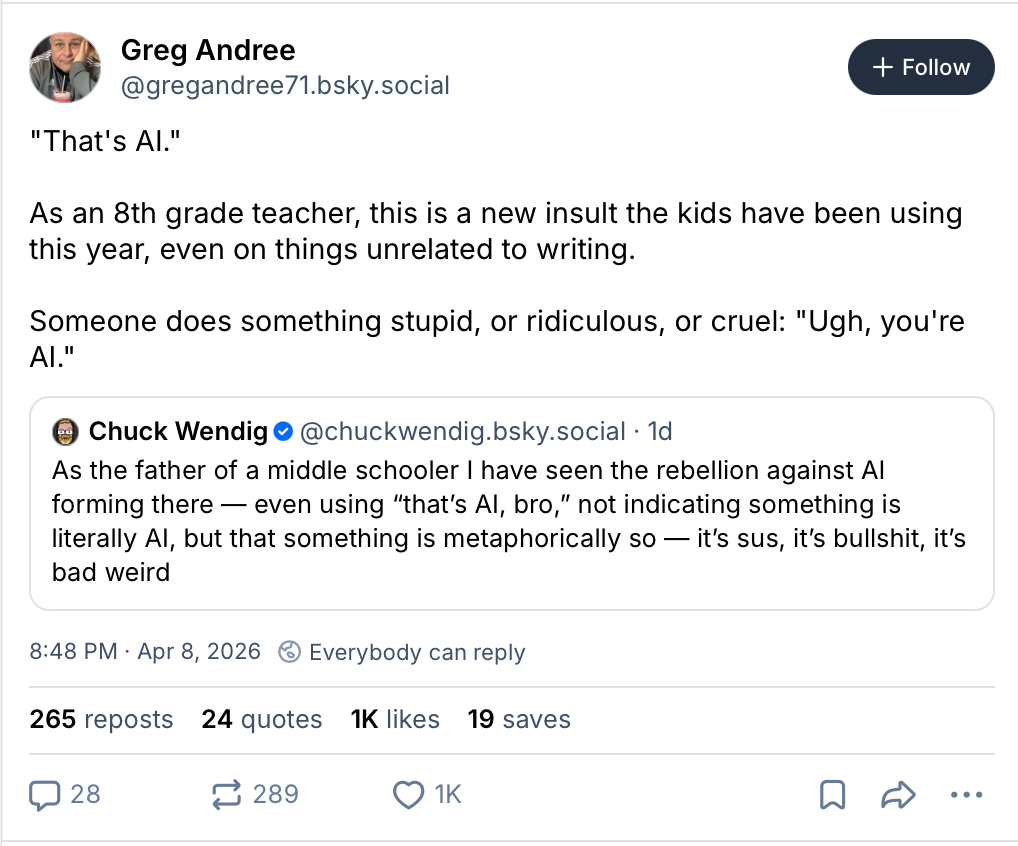
- According to the latest Gallup polling, GenZ’s opinion of “AI” has declined 14% since 2025. I really do have to congratulate each and every “AI in education” advocate for latching onto a wildly unpopular technology and making its awfulness your whole identity

Today’s bird is the long-tailed tit, the only bird in the Aegithalidae family found in northern Eurasia. It’s a wee little bird, just 5-6 inches in length which includes 3 inches of tail. It makes its nest from spider egg cocoons, spider silk, moss, and lichen. According to Wikipedia, “the tiny leaves of the moss act as hooks and the spider's silken thread provides the loops, thus producing a natural form of velcro.” Velcro was actually inspired by the natural world (not by the tit but by the burr – that's a story for another day); but before we get too excited about human powers of observation and ingenuity, I regret to inform you that this cute little bird was once known as the “bum towel” in England.
Thanks for reading Second Breakfast, or for at least scrolling down far enough to see this message.