Click Here to Comply


Perhaps you’ve read Ben Riley’s exposé on AlphaSchool’s “boot camp” -- along with his follow-up in which the school provides even more creepy details on the bizarre eight-week training program that high school students enrolled in the private school must complete.
Perhaps you haven’t.
Perhaps you’ve blocked from your memory the whole AlphaSchool insanity: the promise of “two hour learning” – two hours a day spent clicking through AI-mediated educational programming – that seems to have captivated the imagination of the usual crowd of tech investors and evangelists (and sadly, a fair number of journalists). I don’t blame you. Indeed, I congratulate you if you've been able to ignore it, as the hype-sters won't let us go a single day without hammering us with how transformative (and terrible) the "AI" revolution will be.
Or perhaps, like me, you simply cannot believe that we’re still talking about this very ridiculous "AI" revolution and, in particular, this very ridiculous school. (I’m cited in Ben’s piece calling AlphaSchool “snake oil” and I stand by that – the “two hour learning” claim merely the latest in a long history of educational gimmicks and fads where some hustler claims their product will enable buyers to quickly, even instantly, acquire new knowledge.)
Honestly, I felt as though Dan Meyer thoroughly debunked the whole premise of the school – and not just the “two hour learning” with “AI” instead of teachers bullshit – when he first wrote about AlphaSchool over a year ago. Over a year ago.
But instead of letting a bad idea fade away – and yes, we could say that for this whole “AI” brouhaha – there’s a group of very committed people sold on, and in turn, selling the story. It's exhausting and it's depressing, particularly as too many decision-makers in too many places still believe there is a magic ed-tech bullet. AlphaSchool keeps expanding to new cities and new states, even though it’s never being able to show that it works for all (or hell, even most) students. Indeed, reporting from Wired and 404 Media (and elsewhere) has underscored that there are all sorts of bad things afoot: both in the AlphaSchool software systems and in the classrooms themselves.
(I’ve noted this before...) There’s a scene that’s been stuck in my head for over a decade now, from a 2012 episode of PBS NewsHour, in which journalist John Merrow explored the promises of “hot new startup/school” of that decade: Rocketship. The charter school chain was also technology-driven (and tech-investor lauded and funded); it also promised to replace teachers with algorithms. Its students, most of them Black and brown children from lower socio-economic backgrounds, sat in colorful cubicles for much of their day, headphones on, bored and isolated and clicking away at their lessons.
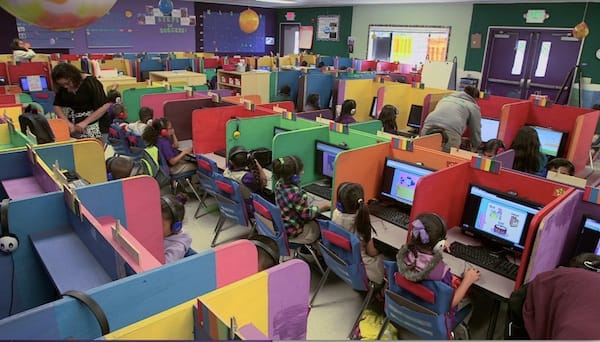
For its part, AlphaSchool also has plans to expand into the (historically pretty terrible) virtual charter school territory. But the schools that have made most of the headlines have been its private brick-and-mortar locations – those with tuition that ranges from $10,000 to $75,000 per year. The target population for AlphaSchool aren’t disadvantaged students; and I suppose it might be easy to argue that these more privileged students will be fine even if the two hours of mandated teaching-machine-time is less than ideal, as the rest of their school day (and, of course, the rest of their lives) will be full of fun, enriching activities and opportunities.
“What the hell are we doing to these children?” I thought when I watched PBS NewsHour. To me, Rocketship exemplified the ways in which – despite all the language of “progress” often wielded to make ed-tech seem appealing to schools, to parents, to communities – these technologies and associated practices served to reinforce regimes of surveillance and control, utterly dehumanizing students as it datafied them.
Many of the charter schools that were so popular – then and now, I suppose – with the ed-tech and ed-reform crowds also touted a focus on “character education.” They demanded compliance, indeed often silence, from students. These programs were obsessed with behavior, linking students' outward expressions to their inward development.
AlphaSchool is eerily similar, even though its private schools are not marketed to low-income or marginalized families. AlphaSchool too operates a regime of surveillance and control. As Ben’s reporting underscores, it too is committed to dehumanization, humiliation, shame. And personalized learning software – whether you market it as “AI” or not – always relies on behavioral engineering.
But the “character education” that AlphaSchool doesn't demand silence or compliance in the same way – again, the appeal here is to parents who believe their child is the next genius tech entrepreneur billionaire. But it is damaging in its own right. AlphaSchool, as we can see in the details of the bootcamp, actively demands students mold their behavior and their identity, in this case into some sort of John Galt figure. The school's programming leans into the kind of pseudoscience that litters the pages of bestselling “get rich quick books” – psychological pseudoscience, economic pseudoscience alike – and the ideology of Silicon Valley's startup hustle. All of this is the kind of messaging you can regularly find on social media, no surprise, since this seems to be a school fixated on the anti-expertise of influencer-culture, the sociopathy of tech-culture: move fast and break things.
“What the hell are we doing to these children?”
“Do not obey in advance.”
I often think about Timothy Snyder’s first lesson in his book On Tyranny – his guidance for protecting democracy. "Do not obey in advance." It works for fighting fascism; it works for fighting "AI" – they're inextricable.
Harvard’s president made the press rounds this week, with interviews in The Chronicle of Higher Education and in Derek Thompson’s podcast/newsletter and probably elsewhere too, talking about how “everyone is using ‘AI’ all the time for everything” and thus you should too.
"Do not obey in advance."
This week it seemed as clear as ever that “AI” is being marketed, even by its makers, as a threat. A threat to everything and everyone; a threat to life, to the very idea of future itself.
And sure, it’s a lot of “misleading metaphors” as Melanie Mitchell put it. I don't think that "AI" is going to kill us all (although the rapacious, climate-destroying commitment to fossil fuels and data centers is sure gonna try). But when "AI" proponents say this, they really do mean it as a threat, even if they don’t necessarily believe it to be an existential one. "AI" is a threat, and they want us to comply. They want us to consume. They want us to obey. They want us to click. They want us to cower. They want us to fear. They want us to be reliant on their machinery, their answers, their ideology.
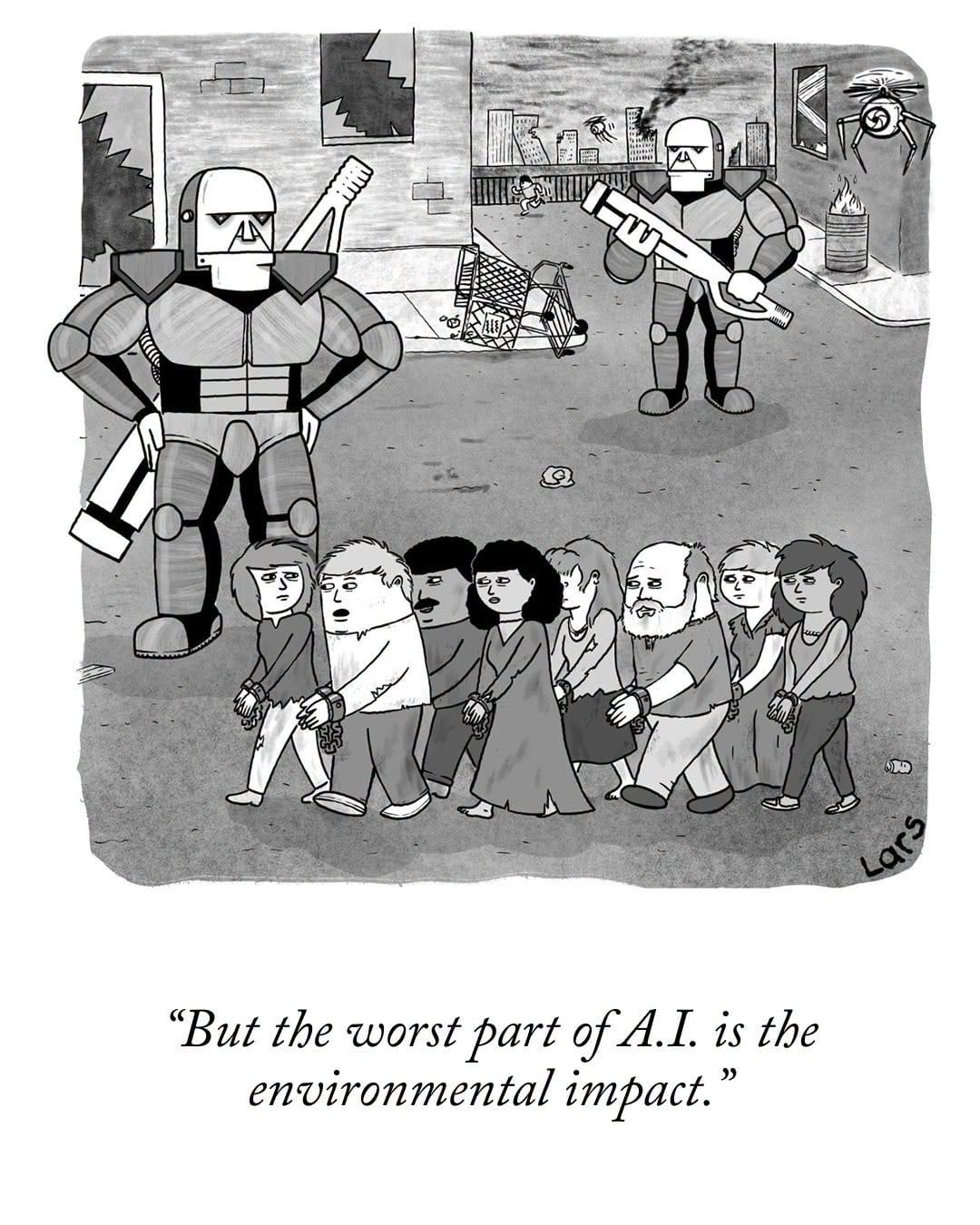
Of course, as Ryan Broderick put it, “AI is still boring and also bad and also expensive.” Resisting it really shouldn't be that hard. It sucks. Software sucks. The oligarchs' vision of the future sucks.
There isn't really conclusive evidence that asking "good questions" means that you get better answers from "AI." I know it might seem true. We're taught that asking good questions – learning to form and ask good questions – is essential to knowledge acquisition, to knowledge expansion. We glorify the Socratic method. We admire people like Terri Gross, for example, because as an interviewer she has a knack for asking very good questions that, in turn, elicit very interesting responses from the guests on her show.
But that is not how LLMs or chatbots function. "Good questions" aren't necessarily what elicits "good answers" – indeed no amount of "good questions" will consistently lead to a "good answer" from a probabilistic technology. Learning how to type "good questions" into the chatbot, teaching students to think of their inquiry as "prompt engineering” – these involve demanding students bend their thinking, in form and in content, to suit the interface, the machinery of surveillance and extraction.
Sure, asking questions is important. We should all wonder. We should be curious, and we should all have the right and the courage to question. But forming those questions – even outside the chat interface – is just one piece of how we think and learn. The questions themselves are never really the goal; but nor are some sort of finitude in the answers we uncover in turn. And questions are not always framed first or formed fully before understanding starts to happen.
We aren’t machines, so let’s stop instrumentalizing every part of our cognition, constrained by that terrible metaphor.
(We might stop to think too how, in light of all the compliance that the technology industry craves from us, “good questions” – again, whatever that means – are the one place where they promise we will still retain agency and control over "AI." See? Maybe “good questions” really don’t matter at all.)
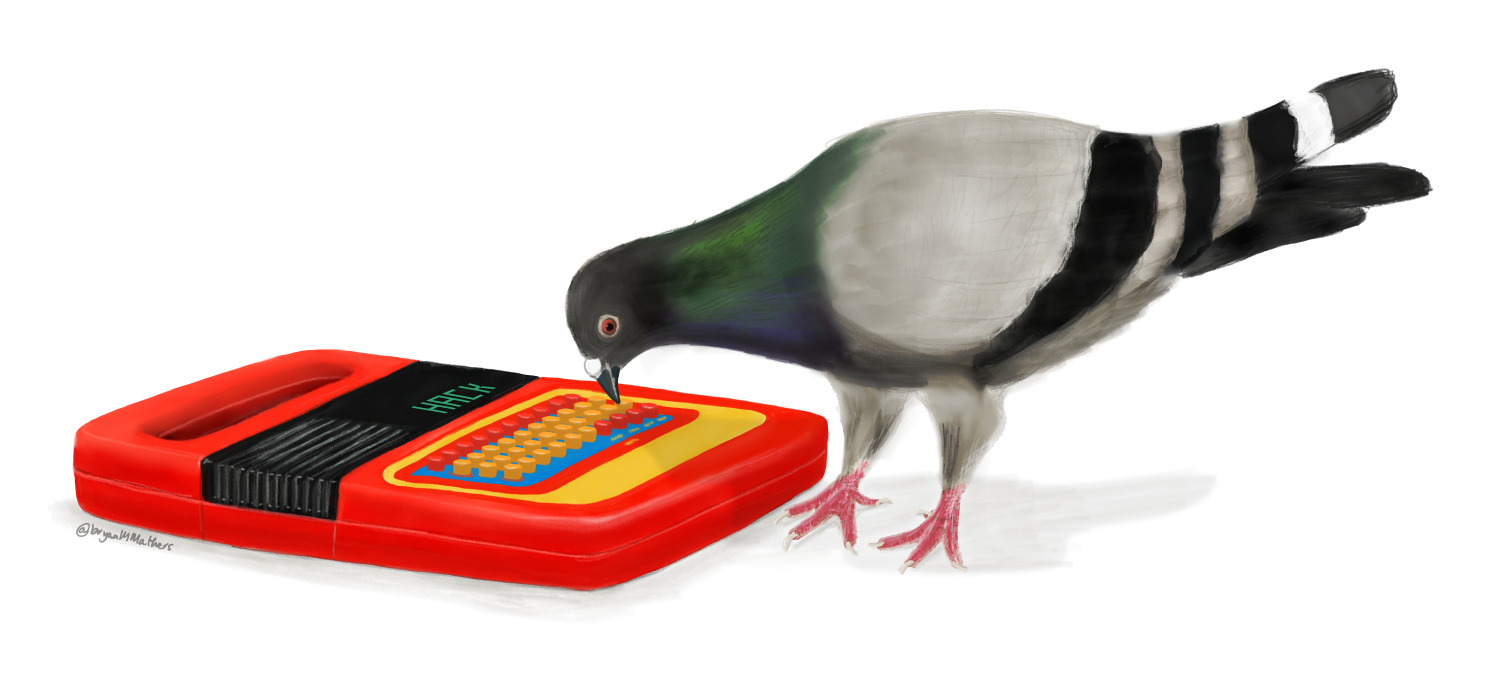
“Comparable results have been obtained with pigeons, rats, dogs, monkeys, human children… and psychotic subjects. In spite of great phylogenetic differences, all these organisms show amazingly similar properties of the learning process. It should be emphasized that this has been achieved by analyzing the effects of reinforcement and by designing techniques that manipulate reinforcement with considerable precision. Only in this way can the behavior of the individual be brought under such precise control.” – BF Skinner, “The Science of Learning and the Art of Teaching” 1954
Some zoos are using “high tech” toys to stimulate their captive animals, and The Atlantic asks “Could high-tech toys help captive animals act more wild?”
What the hell are we doing to all of creation?

Today’s bird is the Namaqua dove. I’m also fascinated by which birds get the “dove” moniker and which are stuck being “pigeon.” The Oena capensis is a pigeon – a very small pigeon and the only species in the genus Oena. The bird is only about 22 centimeters in length (about the size of a budgie, for reference), including its very long tail. Its range extends from sub-Saharan Africa to the Arabian Peninsula.
Thanks for reading Second Breakfast. Please consider becoming a paid subscriber, as your support is what allows me to do this work. Normally, in these Friday emails, I just link to a lot of depressing news. Instead, you got many paragraphs of depressing verbiage written by me. Surely that's worth something, eh?