
Come Up to the Lab and See What's on the Slab


You could argue, I suppose, that recent chatter in and around the field of education technology is only reliant on cliches because it’s the summer (in the northern hemisphere, at least), and everyone’s brain is in some sort of low-engagement rest-mode. I’m not saying that’s my argument; I think that there are probably other reasons -- I daresay technological reasons -- why people keep parroting, sometimes quite literally, the same line. But it's not always memetics that prompts these repetitions, even it can sure feel that way.
“Don’t throw the baby out with the bathwater” -- we’ve heard that over and over and over again in recent months as education technology companies and advocates have sought to counter the growing pushback against technology (writ large, not just in schools) from students, teachers, parents, communities alike. And as Dan Meyer correctly pointed out back in July, “Edtech developers all seem to think that they are the baby, not bathwater, and I am very sorry but you cannot all be baby.”
A couple of weeks ago, when I talked to Alexander Russo from The Grade, he asked me a question along these same lines: which technologies would I toss and which would I keep. “Toss them all” was/is my answer, mostly because I refuse this the expectation that we secede any more ground in education to industry. I’m tired of this insistence that schools and communities (and all the people in them) bend to the designs and desires of the machinery because surely some companies are “the good guys,” some uses are “responsible,” or some products purportedly raise test scores.
In the end, I think that “which technology” is the wrong question, the baby and the bathwater the wrong idiom, because this focus on gadgets and apps and algorithms -- the good ones and the bad ones, the ones to keep and the ones to toss -- always insures that the problems and solutions in education are framed almost exclusively in terms of the technology itself.
This means, in part, that the pushback on ed-tech is framed in terms of “bans” -- that is, in terms of an absence or a lack -- rather than as an opportunity to do something else with the limited amount of time that one has in a class, in a day, in a week, in an academic year. There’s always an opportunity cost in any curricular or instructional decision; educators know that. But ed-tech proponents make it sound as though the cost of not using technology means that there is somehow nothing in its place.
The ed-tech industry and its advocates, no surprise, are insistent that ed-tech is and must be how teaching and learning happens. They seem to be unable to imagine any alternative, which is both incredibly sad and pretty damn cynical. But using ed-tech should never be the goal. The goal, broadly speaking, is to learn how to be human, how to be part of humanity. The goal is to create the conditions -- in a lesson, in a classroom, in a school, in a system -- where students and teachers alike can practice what matters.
What matters is not “using technology” -- unless, of course, you have thoroughly subscribed to the industry’s vision of students and teachers as users, as consumers.
All this talk about ed-tech products -- and to be clear, we would be much better off if we used language that signaled these are products not “tools” or “technologies” -- all these efforts to neatly separate products into the “good” or “bad” or “baby” or “bathwater” designation. When this is the focus, we’re still caught up in the industry’s game: we’re just reducing everything to market transactions -- reducing people to data points products.
And we’re doing so instead of talking about values, purpose, experience -- the things I think we really want to be focused on. We’re never going to support a human-centered education if we’re all so busy centering machines as the mission of our efforts.
Bad Bad Deja-Vu
I honestly cannot believe that we are still hearing about this terrible company and its snake-oil claims about 2-hour education. But here we are. Or here Scientific American is with a look at Alpha School: “Alpha School wants AI to teach a billion kids. Should it?”
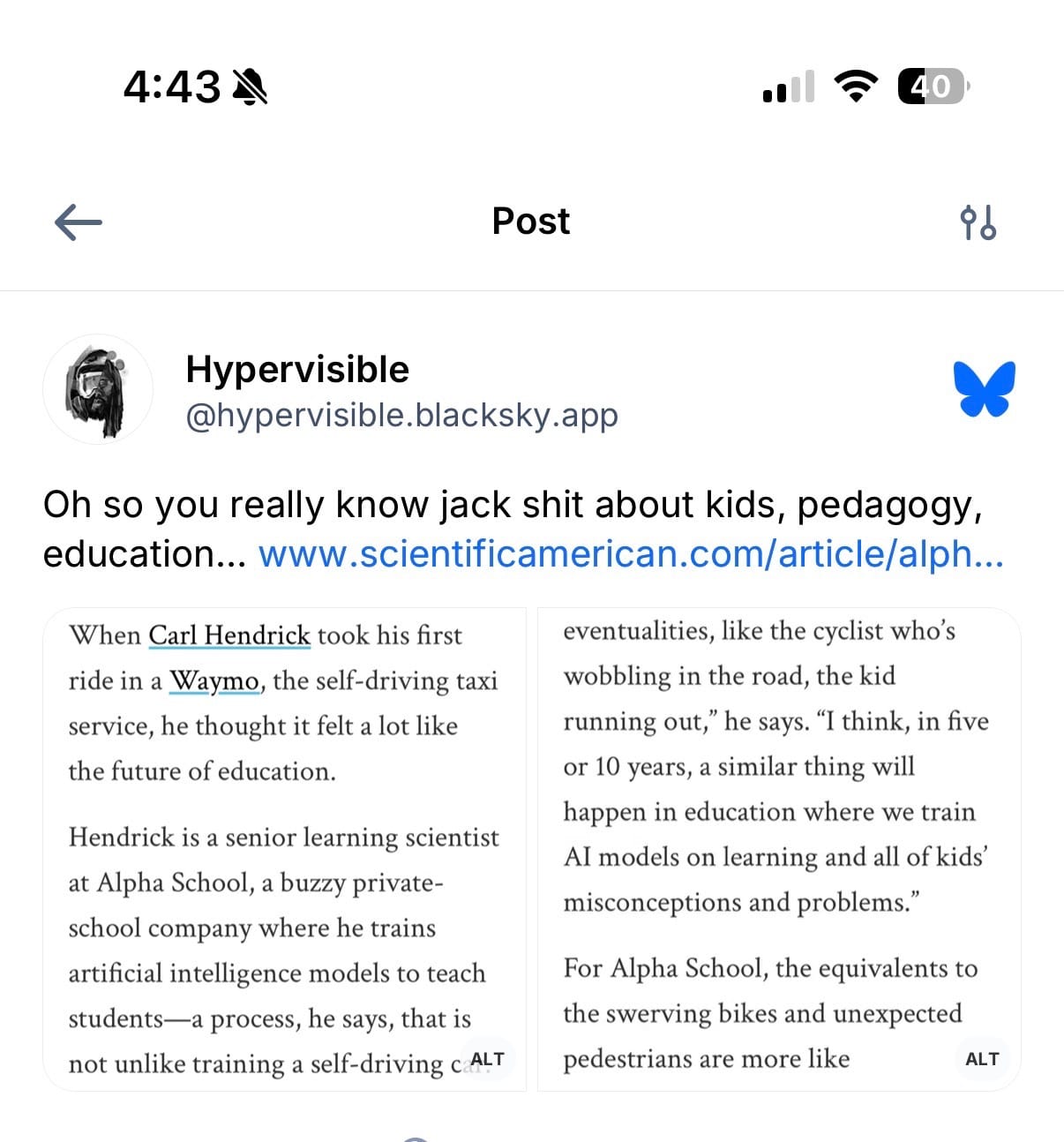
For what it’s worth, Udacity founder Sebastian Thrun definitely got here first with the self-driving car analogy. (And at least he knows something about self-driving cars?) He did so about 15 years ago -- remember MOOCs? Nah? So this isn’t really “the future of education” at all. It’s some dipshit amnesia.
Speaking of MOOCs and dipshit amnesia:
“Harvard Is Selling a $699 Course Taught by A.I. Clones of Its Faculty,” Sarah Kessler reports in The New York Times.
First, Do Much Harm:
Wired’s Vernon Silver, Stephanie Davidson, and Priyanjana Bengani on how mobile apps are increasingly being “designed for addiction” -- and how many of these are targeted at children.
Related, no doubt: Meta’s decision this week to settle the lawsuits claiming it harmed young users. It’s maybe not the coup de grace we’d like to see, but “As Meta Enters Its Zombie Era, Every Blow Counts,” Julia Angwin argues in The New York Times.
Matt Barnum on a new study on Khanmigo: “The problem with an AI tutor: Students don’t want to use it.”
From WNYC: “How AI Chatbots are Infiltrating Classrooms”
Ben Riley on “The 50 Percent Problem: Empirical evidence of the educational harm of generative AI.”
“Students should only use AI for things they already know how to do well,” Daniel Willingham writes.
“What happens when a kid’s robot best friend dies?” asks Sara Harrison in MIT Technology Review
“The Purpose of a System is What It Does”
“They Dedicated Their Lives to Teaching. Then the Deepfakes Started” -- Caroline Haskins in Wired
Via Ars Technica: “Elon Musk’s xAI used child porn to train Grok models, lawsuit says”
I’d be remiss if I didn’t say something about the passing of Dolly Parton, one of the very few celebrities whose education philanthropy wasn’t exploitative and extractive. She wanted kids to read books, she wanted kids to have books because she wanted kids to “dream big, learn everything you can learn, and care for all those who care for you.”
That’s what literacy means, let's not forget. Literacy isn’t simply about the acquisition of specific content knowledge or ticking off titles on some "read this" list. Literacy isn’t about reading test scores. It’s about curiosity and care – and empathetic relationship with the world all around you.

Today’s bird is the red phalarope, a small migratory wader found in the arctic regions of North America and Eurasia. The females of this bird are larger and more colorful than the male of the species; they are also more aggressive, pursuing mates and competing for nesting territory.The breeding female is mostly dark brown and black, with red underparts and white cheek patches. (Not to be confused with the red-necked phalarope, of course.)
Thanks for reading Second Breakfast. Please consider becoming a paid subscriber as your financial support is what allows me to do this work.