
Snow Day


I'm working on a longer essay that I hope to finish up this weekend, but in the meantime, I wanted to send out a list of links to other important stories, essays, podcasts.
I say "that I hope to finish up this weekend," but my weekend plans are very much up in the air, as I'm waiting to see what the weather is like: will there be another big storm? And more importantly, will New York Road Runners cancel the Manhattan 10K on Sunday? (And by extension, will I be writing this weekend? Or will I be racing?)
(FWIW, you can read more details about this sort of personal dilemma if you sign up for my Monday newsletter, "Personal Day" where I write more about food and fitness and some of the other ways in which the tech industry is trying to engineer and "optimize" our lives, beyond education. You have to opt in to this email because I reckon a lot of you are here for the ed-tech criticism and not my thoughts on breakfast cereals or road races.)
As a kid, I loved a snow day. Come on. Who didn't?! I grew up in Wyoming, where the weather is mostly bad – or as my dad would say "we have two seasons: winter and road construction." It snows a lot in Wyoming, sometimes starting as early as August and sometimes lasting until May, so snow itself didn't close schools. Hell, it didn't even stop recess. But maybe once a year, it'd snow so much – or more likely, the wind would blow so hard – that school would be canceled.
Or at least, that's what would happen in the blessed world pre-Internet. But now when there's bad weather – such as has been the case here in New York City on Monday – schools "go virtual" instead. Everyone is supposed to log in to some god-awful piece of education technology from home and make believe that everything is fine and this is how we must "do school," even under the worst conditions – weather or otherwise.
Frankly, it's bullshit.
I know it. You know it. Teachers know it. Students know it. Parents know it. But whatever, I guess we're all so glazed by the stories of the wondrous affordances of education technology that we pretend like "virtual school" is actually a worthwhile endeavor, so much better than – and here the education reformers visibly shudder when they utter this phrase – the learning losses that might happen when children's lives aren't properly engineered, when everyone steps away from their digital devices.
Matt Barnum and Alex Zimmerman wrote about "the downside of ending snow days" in the latest Chalkbeat Ideas newsletter, and hell yeah, it always feels good to have your gut feelings validated by one of these research synopses: "Snow days, maybe surprisingly, are less disruptive than other forms of lost instructional time,” researcher Joshua Goodman tells them. “Coordinating everyone being absent at once is actually easier to deal with than the messiness of other kinds of lost instructional time.”
Let the kids have a snow day, for crying out loud. But also much more broadly, my god, we have to stop pretending like things can continue to go on like this.
From The Economist: "Ed tech is profitable. It is also mostly useless." I mean, shiiiiiit (RIP Isiah Whitlock Jr.) it's not even all that profitable.
Related, maybe: Justin Reich responded on LinkedIn to some recent research on/by Khan Academy ("Computer-assisted learning in the real world: How Khan Academy influences student math learning"): "If 20 years and $100MM+ in research and development builds an online math practice problem system that supports typical learning gains of 0.03SD, what can we expect from other edtech products? What can we expect from AI improvements to edtech products?" ¯\_(ツ)_/¯
In other Justin Reich news, Stanford historian Sam Wineburg is the guest on the latest TeachLab podcast, with the two discussing "AI literacy." As they rightly observe, we still haven't even got web literacy right.
Elsewhere in ed-tech podcasting, Carlo Perrota is the guest on the latest episode of Neil Selwyn's Education Technology Society podcast, and there, those two discuss agentic AI and education: “fundamentally, a ruse,” as Perrotta puts it. (Incidentally, his book Plug and Play Education is one of the very best ed-tech books ever written, and I often feel like I need not write another ed-tech book because Perrotta said everything already.)
Selwyn asks Perrotta about all this chit-chat that someone is going to create an agentic AI that allows students to cheat their way through school. Perrotta scoffs and insists that “That's not going to happen. That's the kind of situation that in the best case scenario is almost like a Wizard of Oz situation. It's a performance of automation, okay? It's basically a fakery. And in the worst case scenario, it requires a lot of actual work. It requires a lot of moderation, a lot of tweaking, a lot of curation in order to achieve the level of performance that is advertised, is expected, or is assumed in the sort of promotional rhetoric.”
It’s noteworthy that in both of these cases/podcasts – that is, with "AI Literacy" and "Agentic AI" – we can see how the ed-tech industry and its hustlers are invoking phrases that are vague if not meaningless, all while gesturing grandly at some radical reshaping of education.
“How AI Destroys Institutions” by Woodrow Hartzog and Jessica M. Silbey
The abstract:
Civic institutions—the rule of law, universities, and a free press—are the backbone of democratic life. They are the mechanisms through which complex societies encourage cooperation and stability, while also adapting to changing circumstances. The real superpower of institutions is their ability to evolve and adapt within a hierarchy of authority and a framework for roles and rules while maintaining legitimacy in the knowledge produced and the actions taken. Purpose-driven institutions built around transparency, cooperation, and accountability empower individuals to take intellectual risks and challenge the status quo. This happens through the machinations of interpersonal relationships within those institutions, which broaden perspectives and strengthen shared commitment to civic goals.
Unfortunately, the affordances of AI systems extinguish these institutional features at every turn. In this essay, we make one simple point: AI systems are built to function in ways that degrade and are likely to destroy our crucial civic institutions. The affordances of AI systems have the effect of eroding expertise, short-circuiting decision-making, and isolating people from each other. These systems are anathema to the kind of evolution, transparency, cooperation, and accountability that give vital institutions their purpose and sustainability. In short, current AI systems are a death sentence for civic institutions, and we should treat them as such.
Related: “The Dangerous Power of Prediction Markets” by Kyla Scanlon
(And yes. Ed-tech is absolutely a prediction market.)
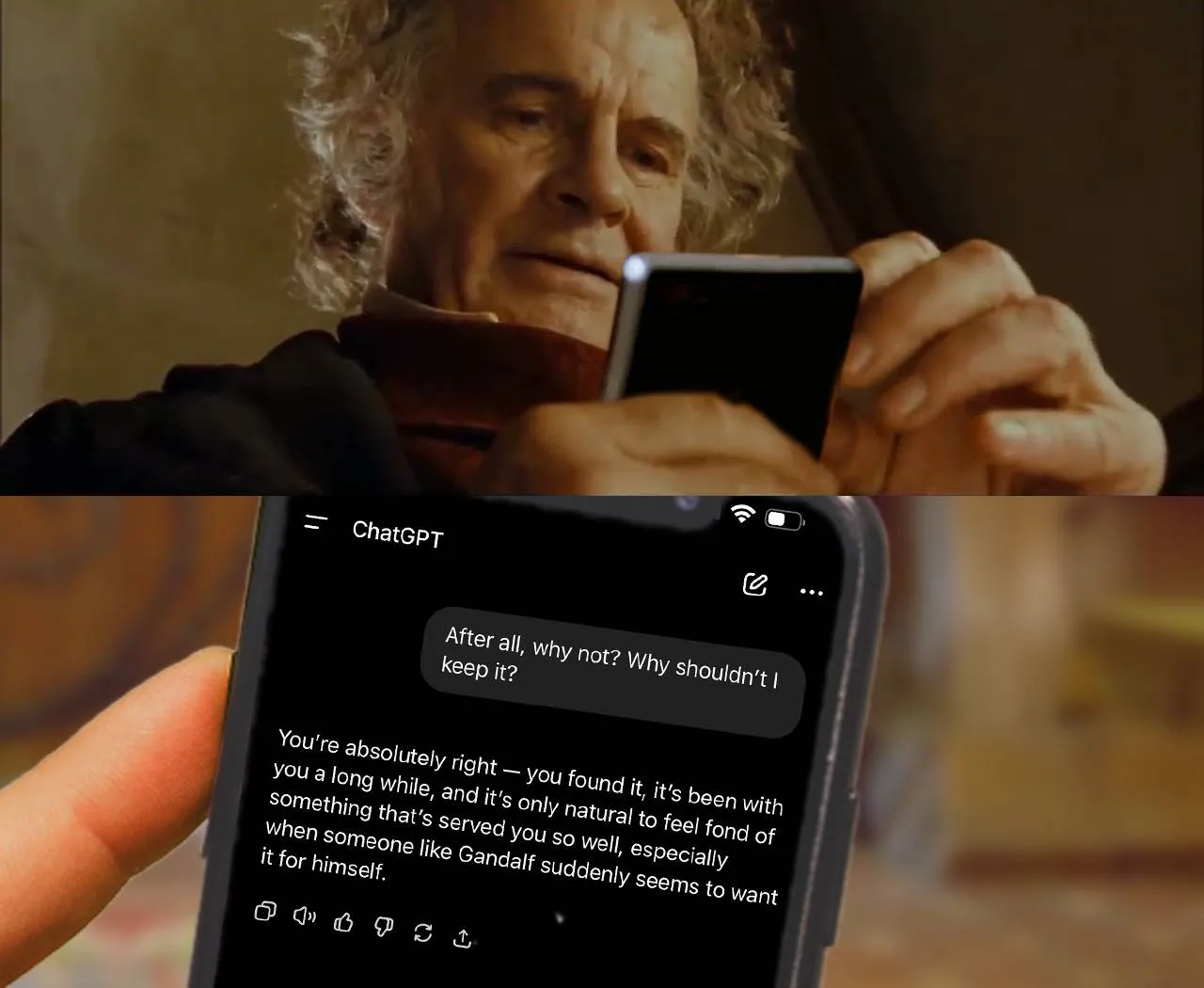
Via NBC News: “Google's work in schools aims to create a 'pipeline of future users,' internal documents say.” Katie Conrad writes about what that pipeline looks like at her university: “When Google Brought Its Monorail to My Campus.”
“Latest ChatGPT model uses Elon Musk’s Grokipedia as source, tests reveal,” The Guardian reports. So, good job everyone who’s signed a school contract with OpenAI. You’ve demonstrated some real moral leadership.
Keep the kids safe. Please. And please start to recognize that “AI” is the very antithesis of this. (To be clear, I don't mean "safe" the way in which the brain-rotted techno-fascists invoke "AI safety." I mean: protect them love them keep them alive.)

Today’s bird is the snowy owl, which I chose because, well, snow. But also because its Latin name, Bubo scandiacus, just sort of rolls off the tongue with the cadence of a magical spell. There’s a snowy owl in a very popular children’s book written by a very terrible person – you know exactly who I'm talking about – and it’s well beyond time we reclaim snowy owls and magical spells from her clutches.
We have a lot of reclamation work to do.
Thanks for reading Second Breakfast.