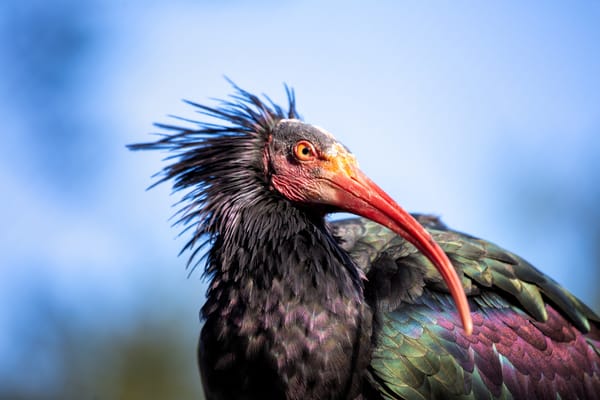
The Ruffled Mind


There's a scene in the 1927 film Metropolis in which Freder, the son of the city's mayor, is playing in the "pleasure garden" when a young woman named Maria brings the children of the working class up to see how their wealthy brethren live. The children stumble forward, rubbing their eyes from the dazzling light. Indeed, the working class live and toil underground as the elite frolic in the skyscrapers above them. The children are brought to "see the light," literally and metaphorically -- to witness what their labor fuels.
Fritz Lang's science fiction masterpiece is set in 2026, and here we are, with a world split into these very divisions: the elite who spend their days playing around with "AI" like it's sport; and the rest of the world, whose blood and sweat (and data) run the machinery.
The children are watching, of course. They're watching and toiling and suffering themselves. And they recognize the gross inequality, the indignity, the injustice.

Liam Ramos, age 5, and his father were taken into custody by ICE. Liam Ramos, age 5, and his father were taken into custody in their driveway in Columbia Heights, a Minneapolis suburb, as they returned home from school. ICE apprehended them, then walked Liam Ramos, age 5, to the front door of his home and had him knock on it to lure anyone else outside. Twenty minutes after they were driven away – they've been moved to Texas, The Guardian reports – Liam's older brother, a middle schooler, arrived home to find his family missing.
Liam Ramos is one of four school children detained by ICE in the school district this week.
The children are watching. They understand what sort of world is being constructed for them: this careless, thoughtless, heartless insistence that their lives be bent to appease the algorithms, that their imaginations and their ideas are inevitably inferior to the banality and hatred spewed from the machine.
The violence of ICE is the future of "AI" and education. All this bullshit that "AI"'s evangelists are peddling about a more efficient and productive school day are moot when the efficiency and productivity that matter the most under techno-fascism are bound up in surveillance, control, and eugenics.
Who will want to send their children to school under these circumstances? This is how you destroy institutions – not just by attacking them directly, which is obviously happening here too, but by destabilizing the ground under which they're built.
Who will want to send their children to school under these circumstances?
I mean, other than the glut of men who just keep writing and writing and writing about their nifty "AI" projects as though all this is just so cool and fun. They're so clearly have a grand ol' time, so much like the party-goers on the rooftops of Metropolis, blithely unaware of and certainly unmoved by the violence on the streets below them.
"The ruffled mind makes a restless pillow" – Charlotte Brontë
More bad news:
- Google announced a new partnership with Khan Academy this week “to build new education tools, powered by our Gemini models” -- an interesting move mostly because of all the marketing that Sal Khan has done alongside OpenAI, touting ChatGPT in his book and 60 Minutes appearances as the LLM underpinning Khanmigo. As Justin Reich notes, this announcement raises all sorts of questions about what’s going on “under the hood” of that product, but also about how schools and districts should be evaluating “AI,” particularly when the algorithms/models/corporate-provider/data/money shifts around underneath the wrapper that’s been packaged up and sold to the education market.
- “Something Is Wrong With Russia’s Children,” writes Anna Nemtsova in The Atlantic. “For years, children in Russia have watched their country massacre Ukrainians and condemn hundreds of thousands of its own citizens to injury and death at the front. As violence has come to surround Russian youth, many seem to have become more violent themselves. Last year, the number of juvenile crimes in the country surged by 18 percent. Authorities also reported an uptick in “serious and especially serious” crime. ‘There is no positive ideology for children in a country fighting a murderous war,’ Ilya Barabanov, a Russian journalist, told me. Instead, the war has amplified worldviews that encourage brutality.”
- Also in The Atlantic, Sophie Gilbert writes about Renee Nicole Good, Grok, and the hard-coding of misogyny into our political and technological infrastructure. “This year will decide whether the hatred of women becomes the norm,” she says.
- Ben Williamson lays out some of the different frames and framing of “AI” in schools: “Constructing AI in Education.” He repeats his contention that “AI” is a “public problem” “rather than an ‘entirely positive’ phenomenon. It has been encouraging to see European educator unions promoting the idea of teachers as “active shapers of policy and practice” around AI, which indicates how re-framing AI in education has become a collective union matter of concern. It still seems to me to be important to continue the work of re-framing AI in education before the dominant constructions outlined above become so settled and integrated into our institutions and practices that they prove impossible to deconstruct.”
- Writing for New York Magazine, Jeff Selingo asks “What is College for in the Age of AI?” and damn, there is some grim stuff in here about the labor market, along with this steady refrain that education is all about, only about job training. (And, of course, all the people you’d expect to be cited here repeat the story that colleges are failing at this “jobs of the future” mandate.)
- And the best for last: “Alaska Art Student Arrested for Eating Another Student’s AI-Generated Art in Protest.” Goodness, and some people say that college students aren’t learning what to do in the face of an “AI” future.
Today’s bird is the common eider, a very large European sea duck that can be found in the Arctic (in and around Greenland – that’s your news tie-in). The eider was, historically – as the name suggests – the origin of eiderdown, the soft features used to stuff pillows and quilts (although enshittification comes for everything, including feathers I guess and these are more likely these days to be harvested from domestic geese, if not replaced by synthetics altogether).

Thanks for reading Second Breakfast. I’ll be back soon with an essay on “AI” and delusional thinking, but it’ll just be for paid subscribers, I reckon. Meanwhile, please step away from the computer. And do stay safe out there.