Broken Record


I often feel like I’m repeating myself here, because in fact I am. I am, in part, because ed-tech entrepreneurs and evangelists keep repackaging the same ideas, desperate to sound innovative instead of stuck in some Cold War science fiction fantasy. “Intelligent tutoring systems” become “adaptive learning” then “personalized learning” and now AI tutors, for example.
I thought I’d write something about conversation-ending cliches in today’s newsletter -- about the ways in which certain phrases get trotted out repeatedly in education-technology and serve to shut down debate and inquiry. You know the stuff: all the talk about the inevitability of AI and the “jobs of the future” and whatnot. Then I remembered that I’d written about this very thing: about psychologist Robert Jay Lifton’s notion of the "thought-terminating cliche" as a way to end a conversation and, importantly, to silence criticism or doubt: "brief, highly reductive, definitive-sounding phrases, easily memorized, and easily expressed. They become the start and finish of any ideological analysis,” as he put it. It’s a rhetorical tactic of cults, Amanda Montell argues in her book on the language of fanaticism.
I wrote about this very thing not even six months ago. It’s as good a sign as any, I suppose, that I need to take a little break. But truthfully, it’s May 1 and the first couple of weeks of May are just really, really hard for me. My head and heart aren’t here; they’re there.
There were some really important stories this week: the news from ASU, for starters, about the school’s new “AI” tool Atomic that, without professors’ knowledge or consent, has vacuumed up their course materials from the LMS -- lecture materials, videos, and so on -- to train a chatbot that will offer “personalized” (LOL) micro-lessons full of short, fast AI slop. (For the bargain subscription fee of $5/month.)
Ben Williamson observes that this is part of a push on the part of universities to reduce everything to a data asset that can be further monetized. That is, this isn’t simply about the elimination of faculty labor and expertise through automation -- although it is assuredly also that -- but the turn in the purpose of of higher education institutions from “academics” -- teaching, learning, research -- to “financialization.” It shouldn’t be a surprise that ASU is at the forefront of this, with its long history of working with GSV and its connection to the god-awful ASU-GSV event (bonus: ASU professor wil.i.am and “AI” “future-proofing”).
Something about thought-terminating cliches and cults there, for sure.
So here are a bunch of links to a bunch of stories that hopefully you won’t spend your weekend reading. Hopefully you’ll be offline, outside.
I will be. And I’ll be back in a few weeks, not with a clear head or happy heart. But I will be back.
More bad technology vibes:
Jill Barshay writes about new research that’s found that “AI gives more praise, less criticism to Black students.”
“Silicon Valley-backed companies are selling $50,000 genetic tests to anxious parents, despite shaky science,” writes Christopher Cox in NY Mag.
More eugenics in this piece in The Wall Street Journal: “How Silicon Valley’s Brightest Parents Broke Their Own School.”
“The more young people use AI, the more they hate it,” says Janus Rose in The Verge.
“I took an algorithm to court in Sweden. The algorithm won,” writes Charlotta Kronblad in a story about algorithmic decision-making and school admissions.
“NYC withdraws plans for an AI-focused high school,” The Gothamist reports. Good riddance.
John Herrman on “My Adventures Setting Up an OpenClaw Agent”:
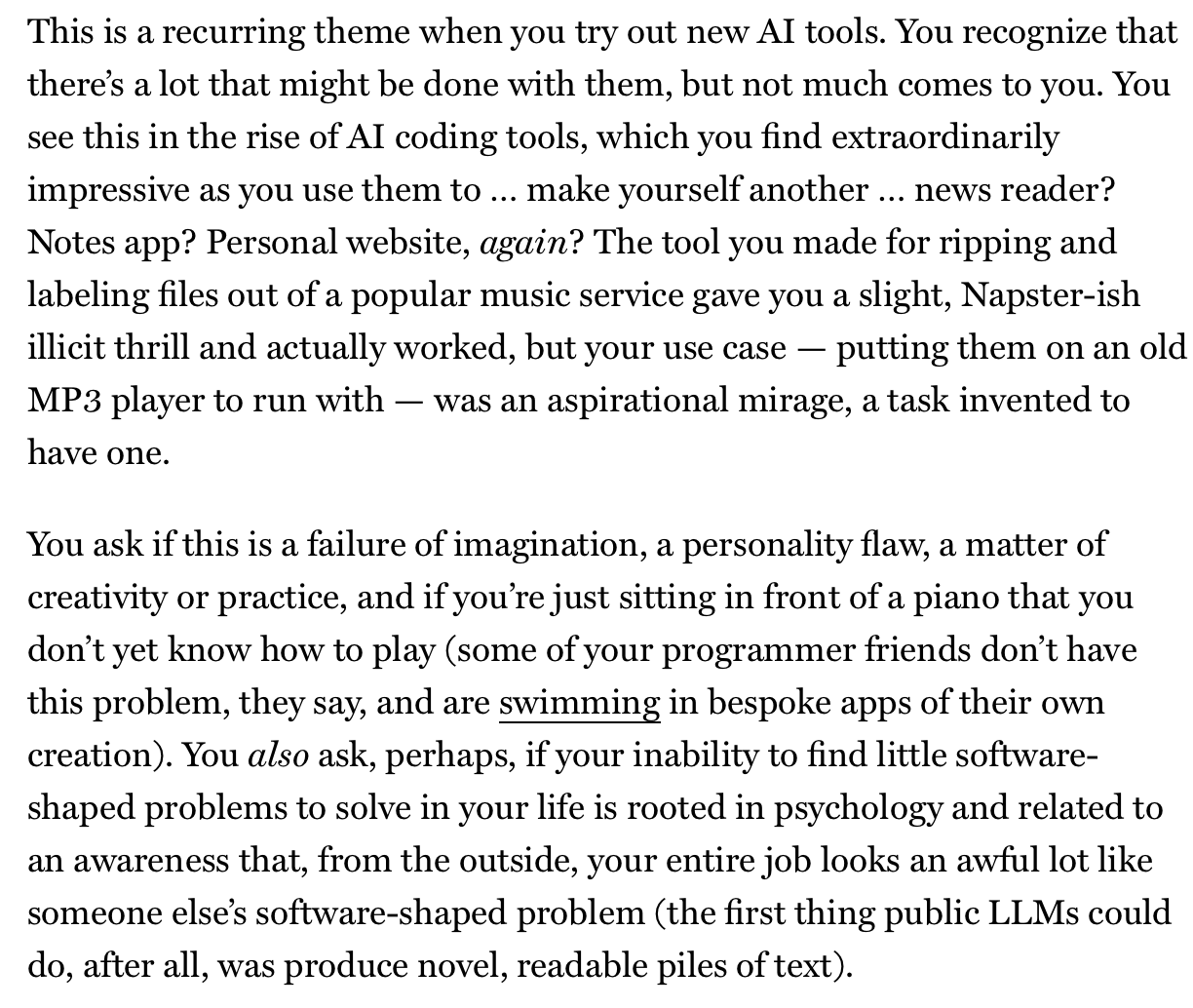
Just because you believe you have a software-shaped hole in your life doesn't mean you should force students to think they have one too.
Via The New York Times: “How A.I. Killed Student Writing (and Revived It)”
Jennifer Berkshire examines some of the reasons why we’re seeing “the big tech backlash.” I think I'd add this reason: it sucks! Computers suck! Stop pretending like it's amazing! If "software ate the world," as Marc Andreessen cooed back in 2011, then what it's shat out since then is what we're living in now, and it's awful.
News about that other menacing technology, the car, that, much like the computer, is all wrapped up with cliches about inevitability and individualism and "what choice do we have?!?": “Walking near a D.C. school raises the chance of being hit by a car, data shows.”

Today’s bird is the little ringed plover. Its Latin name is Thinornis dubius – “dubius” meaning dubious (shocking, I know), doubtful, uncertain. The bird isn’t uncertain, but naturalists were. (Imagine that. Uncertainty from scientists.) Was this a different bird than the common ringed plover, they wondered? And yes, it is. The latter does not have the distinctive yellow eye ring that the little ringed plover can boast. (The common ringed plover, to its credit, does have lovely orange legs.)
Thanks for reading Second Breakfast. I'll be back in your inbox mid-May.