Of Course They Booed


Every spring, we get a flood of stories about college graduation ceremonies -- typically full of tut-tutting about inappropriate behavior or inappropriate speech -- always presented as synecdochical of all of higher ed. Oh sure sure, there’s often the odd tale of triumph: someone’s service dog gets a diploma; someone in their 70s finishes medical school. But mostly these stories serve to reinforce other, more dour narratives about college students -- unprepared, entitled, intolerant -- and about college itself -- irreverent, irrelevant.
This year, despite a brief attempt to gin up controversy surrounding NYU’s selection of Jonathan Haidt as its commencement speaker – sigh, yet another tale of "the coddling of the American mind" – the coverage has focused on the chorus of boos whenever speakers heralded this glorious "AI" future students are poised to step into.
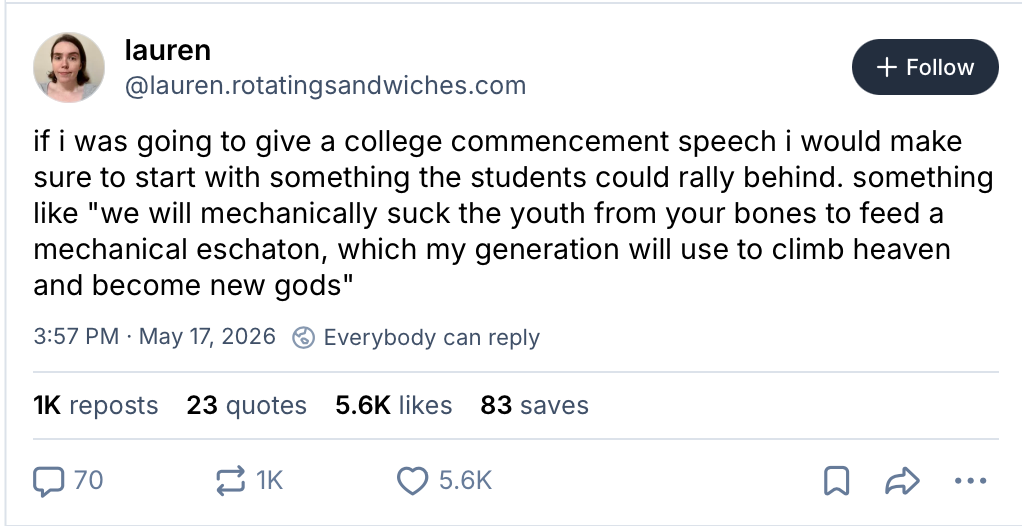
And perhaps it’s a little ironic that this graduating class, a group that we've been told time and time again has spent the last four years using ChatGPT to cheat their way through college, would display such sour sentiment towards "AI." But as most commencement speakers seem duty-bound to repeat, graduation marks the entry into adulthood; it is "the beginning of your life"; "the future is now" – that sort of thing. And just these students are now officially adults, they’re being told a very different story: that there really is no future. There are no jobs. And whatever thing they might have learned to do or learned to love in college, whatever career they might have believed they were preparing for, "AI" is going to destroy all of that.
No wonder they boo.
Here these young people are, having just done everything they were told to do to be successful. They got good grades in high school. They did all the extracurriculars. They scored sufficiently well on the SATs. They were admitted into college – maybe not their first choice, but they got in somewhere, and dammit, they stuck it out for four maybe five years. They completed all the coursework, sat through all the Zoom lectures and the in-person lectures and through all the AI-proctored and in-person exams. They checked all the digital boxes, submitted their homework through the LMS portal's plagiarism-checker, responded to at least two classmates posts on the LMS discussion boards. They used "AI," fine sure but fuck it, because the technology sure used them too. They handed key decisions over to algorithms – not just what YouTube videos to watch while they scrolled through the digital textbooks but what courses to take so that the whole effort of the degree was manageable. Because along the way, the majority of them also worked at one or more jobs; and the majority of them went into debt.
They were promised that if they did all this, if they received a bachelor's degree, then they'd be able to get a good job and make a decent living to support themselves and support their families. But now, even before their diplomas are in hand, they're discovering that the promise was a lie. There aren't any jobs for college graduates, they're being told. All this is supposedly thanks to "AI," a technology that these students know probably better than any other group out there, churns out the most laughably banal bullshit.
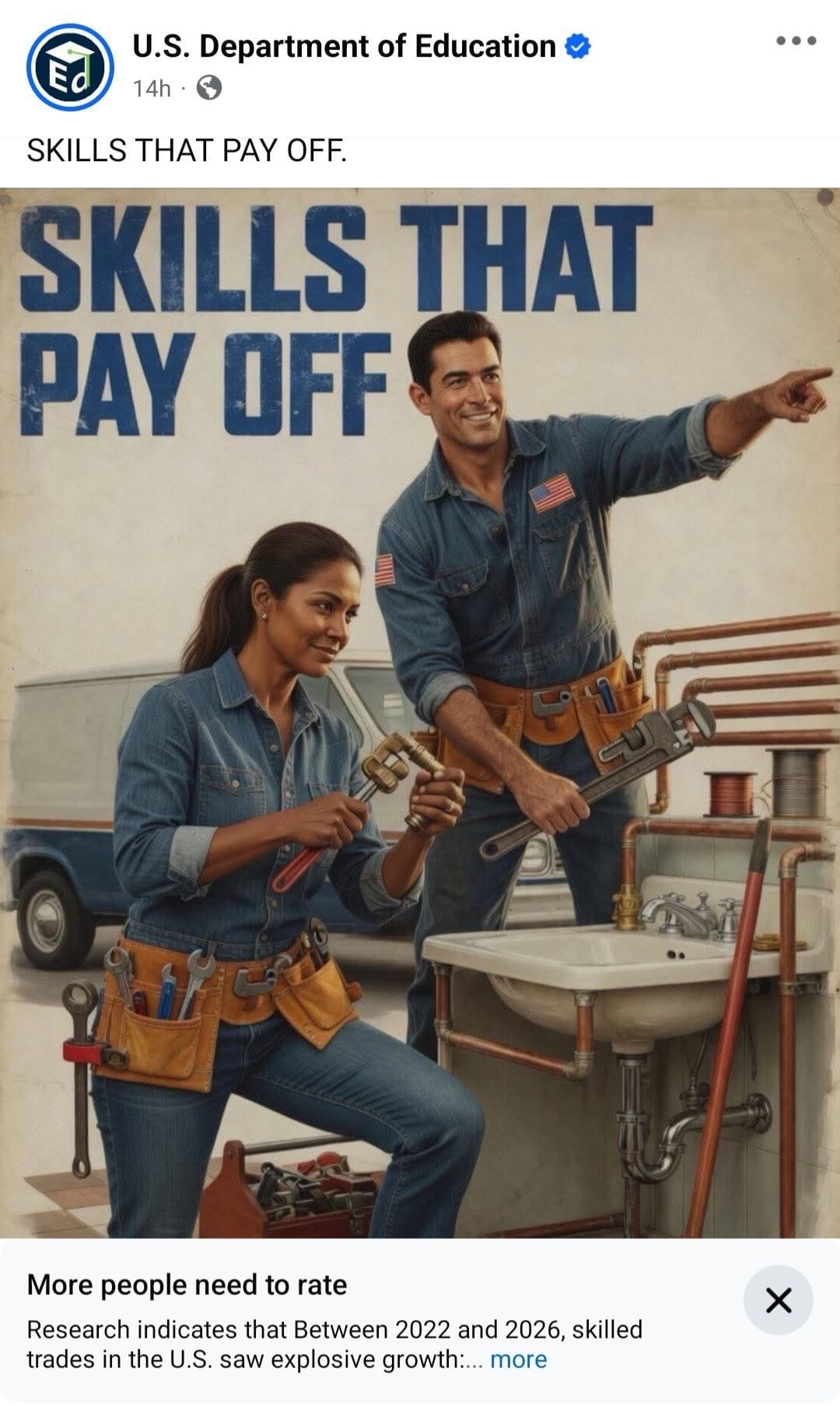
The whole "digital natives" trope is undoubtably hogwash -- the ridiculous idea that young people, by virtue of being born into a world of computational machinery are more adept at its manipulation. These students have spent their whole lives being taught, cajoled, entertained, and surveilled by computers and algorithms -- in and out of the classroom. (But importantly, in.) But they recognize now -- if they hadn't already -- as rejection letter after rejection letter hits their email inbox, that they're being spurned by this same machinery that they’re supposedly most in tune with. “Those who live by electronics, die by electronics. Sic semper tyrannis,” as Kurt Vonnegut wrote in Player Piano -- not really a message you want to hear on graduation day, a ritual that’s meant to mark beginnings and possibilities. But nor do you want to hear someone hyping the very technology that has just sent you some stale, autogenerated text denying you yet another job interview.
All mention of “AI” does is remind them of the political economy from which this monstrous extractive machine has emerged, remind them that their options and their opportunities appear to be utterly foreclosed.
They have no choice. They have no agency. They must comply. The future is written, these smug (and affluent) "AI" boosting graduation speakers have the audacity to tell these students. Just suck it up. Deal with it.
It's this sneering attitude, I'd argue, that is driving so much of the pushback against "AI" and against ed-tech -- it’s Cory Doctorow’s “enshittification” plus a lot of infantilization. People are sick of being told that these technologies are inevitable, particularly when they can see, because they have experienced, the damage they are causing (all while these technologies are generating the wild profits for a small handful of billionaires).
Welcome to adulthood, the graduation speakers always say. But now, they echo the messaging that Silicon Valley has churned out for years now: you'll have to learn to enjoy the digital immiseration because there's nothing you can do about it. There's no turning back, no getting rid of computers, no option for analog, no alternative.
Students boo because they know it's bad. They boo because they know it's wrong – wrong ethically, wrong politically, wrong historically, wrong economically, wrong environmentally.
It's bad. It's wrong. And it's also untrue, all these pronouncements about technological inevitability. The future is not yet written. No doubt, much like the "digital native" trope, these tales do sadly seem to provide comfort and cover (and conversation-ending cliche) for those whose jobs still entail spit-shining the gadgetry.
In the past, Americans mostly haven't minded this story, because Americans sure love their shiny gadgets. But more and more, I think, they've come to recognize that the shininess barely masks the shit. The promises of techno-solutionism – that any sufficiently complicated problem can be magically fixed with technology (not quite what Arthur C. Clarke said, but close enough) – is less and less believable.
The powerful forces of industry and government (and yes schools) seem keen to strip people of their agency, to prevent them from having any say in the conditions of their work, leisure, learning, life. And not just keen but absolutely thrilled to do so.
But the growing pushback against "AI," and the growing pushback against ed-tech more generally, is not simply a rejection of technology. These efforts are, as Astra Taylor and Saul Levin recently argued in The Guardian, a rejection of the profoundly anti-democratic practices that have pushed technologies into all aspects of our lives without our consent and often in the face of our outright opposition. These technologies have been marketed to us as solutions to all sorts of social problems -- and have done so, in no small part, by bypassing and undermining the very public sphere in which debate and discussion can take place: schools, libraries, the arts, the media.
The adoption of education technology, "AI" or otherwise, has been anti-democratic in practices both big and small. Despite all the talk of progressive education and ed-tech, it has been experienced as something else entirely. Throughout the country for the past few decades Gates (via the Gates Foundation), other billionaire philanthropists, and giant companies have shaped education funding and policy through a combination of technology and testing.
At one point, perhaps, people were willing to welcome devices into schools, into the classroom. They believed the stories, not just that "this is the future," but that future meant something better for everyone. “Access” signaled equality. But as the tech billionaires have embraced authoritarianism and inequality, and as their apocalyptic rhetoric about not just the "end of work," but quite literally the end of the world grows louder and louder -- all while they amass more wealth than anyone in history -- it is quite apparent that their promises about the future do not include us. Their vision of future does not make any space or allowance for our children to choose their own futures.
In their essay in The Guardian, Taylor and Levin chastise the liberals and progressives who have recently been vocal in their criticism of datacenter opponents. (It's an analysis that can readily be mapped to education technology, where many people still insist that their politics are progressive, all while wrapping themselves in the same rhetoric as technology's most authoritarian boosters, insisting there's nothing people can do about the material conditions of their lives other than obey obey obey.) "As usual, ordinary people are ahead of their leaders," Taylor and Levin write, with a nod to Antonio Gramsci. "The remarkable organic growth of the datacenter resistance movement across geographies, economic interests and ideology reflects the myriad harms that come with AI infrastructure and growing anger at the tech elite. The tremendous energy unleashed by these fights, and their sensible and unifying demands, have the potential to form the foundations of a new and powerful populist coalition, one poised to help define a working-class agenda that meets this moment and resonates with disaffected voters. This excellent organizing should be cultivated rather than dismissed."
How do we meet this moment with disaffected students? Probably not by insisting that they need to suck it up and keep using Canvas, eh?
Elsewhere:
"Even If You Hate AI, You Will Use Google AI Search," reads the headline in Wired on the changes Google plans to make to Search. (Spoiler alert: they're gutting it.) This is precisely that anti-democratic impulse that I talk about above, an impulse that permeates the tech industry and its marketing: the language of inevitability and dismissive attitude towards any sort of resistance – "this sucks but you have no choice but go along with it." More via Garbage Day: “An internet after search engines.”
“How Deepfakes Tore a High School Apart” by 404 Media’s Samantha Cole. “Video shows ICE violently arresting Oregon farm workers and using facial recognition” via The Guardian. These are how many communities are experiencing "AI," and if you are advocating for more "AI" in schools, I hope you can recognize that this is what people hear you're calling for.
“What Schools Are Forgetting in Their Race to Embrace A.I.” by David Wallace-Wells in The New York Times.
“My Son’s Math Homework Is Essentially Just Pokémon” writes Will Oremus
“A Technical Deep Dive Is Not a Crisis Response” -- Phil Hill on Instructure's response to its recent data breach.
“The Surveillance Classroom” by Andrew Cantarutti. 404 Media’s Joseph Cox” reports on how “Researchers Wanted Preschool Teachers to Wear Cameras to Train AI.”
“Sycophantic AI decreases prosocial intentions and promotes dependence” by Myra Cheng et al.
“A Year Ago, Experts Worried About NAEP’s Future. Now, the Test is Expanding” reports The 74. Those who are advocating the expansion of testing right now are just wildly out-of-touch. You cannot separate testing and technology, and the latest anti-ed-tech efforts are part of an ongoing resistance to the ways in which all aspects of school have bent towards the demands of standardized testing. "We're going to test your kids even more" is not a winning political message, certainly not if you're interested in democratic educational practices.
Brian Merchant writes about the unionization of IT workers in the University of California system.
The American Academy of Pediatrics has issued new guidance on the importance of recess -- “for the first time in 13 years," as the AP notes. Everyone needs to take more breaks. Everyone needs time and space for play, no matter your age.

Today's bird is the vulturine guinea fowl, the largest bird in the guinea fowl species. Guinea fowls all have unfeathered heads, but the particular shape of the vulturine guinea fowl's bald head and neck is, well, vulture-like. The bird – both male and female – has a cobalt-blue body with long black and white feathers. There are far too many websites IMHO that seem to sell the birds (which breeders promise do well in captivity), and I guess the elimination of Google Search will take care of that online business. Wheeee.
Thanks for reading Second Breakfast.