
That Damned LMS Dependency


For the second time in less than a year, a major disruption to the learning management system Canvas has prompted cries (and headlines) that “we can’t do school!”
In the fall of 2025, an Amazon Web Services outage rendered the LMS inaccessible. At the time, Wired spoke to dozens of affected students who complained that “the Canvas outage threw off their schedules, preventing them from not just submitting and viewing assignments but also from participating in class activities, contacting professors, and accessing the textbooks and other materials they need to study.”
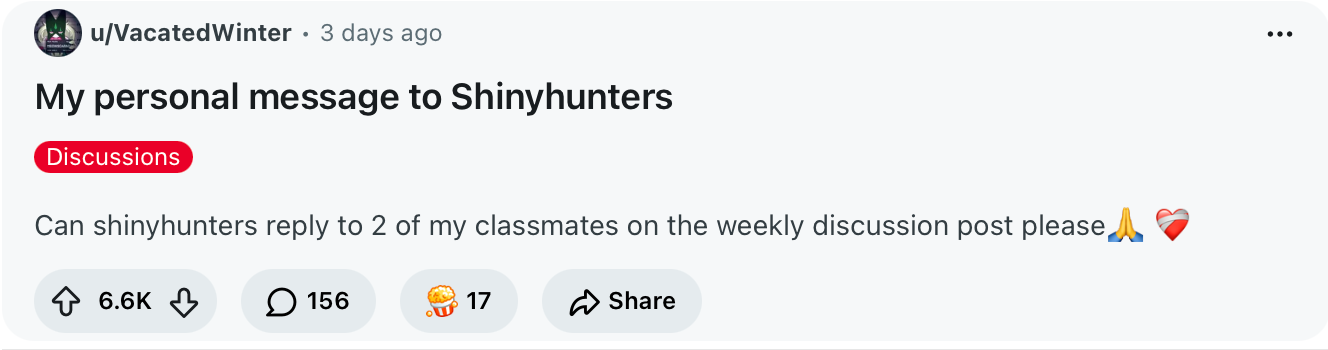
This week’s news was even worse, in terms of timing (finals!) and impact – “'The Biggest Student Data Privacy Disaster in History’” read the 404 Media headline. The LMS was taken offline by the hacking group ShinyHunters, which demanded the company pay a ransom or face a data leak -- data, including names, email addresses, and messages, belonging to some 275 million people across more than 9000 educational institutions (both colleges and K-12 schools).
“Higher education has long been a target of ransomware gangs and data extortion attacks,” Wired’s Lily Hay Newman and Andy Greenberg write. “But never before, perhaps, has a cyberattack against a single software platform so thoroughly disrupted the daily operations of thousands of schools across the United States.”
That is shocking. And no, I don’t mean the size and implications of this massive data breach although yes, sure, of course that’s bad. I mean that this is the story: “the LMS is down. We can’t do school.”
What does it say about education that this particular piece of software – one that was once utterly reviled by students and teachers alike – is not now only ubiquitous across all grades and all levels, but is viewed as essential to its operation?!
Indeed, for all the handwringing about the cognitive dependencies that “AI” might elicit, it seems as though education has already acquiesced to technologies that have cultivated precisely that: the productivity software way of thinking that has convinced people that their work must be orchestrated through some awful user interface. That there is no other way to access information, to complete assignments, to assess work, to talk to one another, without it.
The LMS isn’t necessary. It never has been. But it has sold itself to schools with the promise of convenience and – it’s right there in the name – “management.” In the decades since its introduction, the LMS has reshaped education to suit its design. Assignments, assessments, discussion – these have all been bent to fit the software. Teachers' work and students' work – and their ideas about what academic work looks like – has been bent to fit the software.
No matter the course – Intro to Biochemistry or Beowulf – the interface for a course is the same. No matter the course, no matter the school. Everything has been standardized – that's the goal at least; everything, everywhere is interchangeable. It's all just "content." Everything – except the LMS, I suppose – is replaceable. Everything "cognitive" soon to be automatable. Such was the promise of that recent “AI” agent that boasted it could cheat its way through any course on Canvas. And such is the story peddled in a recent (terribly stupid) New Yorker piece that argued that thanks to “AI”, college will only exist in the future as “a website or app.” Let’s just hope someone can keep that website online.
If college only exists in the LMS, if it cannot exist without the LMS, this means we have abandoned education as anything other than education technology. It means we have abandoned the physical spaces of learning: the campus, the classroom, the professor’s office, the student center, and so importantly, the library. It means we have abandoned the place; it means we have abandoned the people.
Although some of the features of the LMS predate its development – see Brian Dear's book on PLATO, The Friendly Orange Glow – the product appeared in the 1990s, and it has actually changed very little since then.
The LMS was -- and remains -- an online portal to a closed system. And much like other portals of the late 1990s, most famously AOL, the LMS was designed to keep schools and students “safe” from the open Web -- that is, to keep unauthorized people from accessing the content and keep authorized people (tuition-paying students, namely) inside its walls. The LMS served as student and faculty's interface to the data contained in the student information system, that massive database that housed the university academic bureaucracy -- registration, course enrollment, schedules, grades, room assignments, transcripts, and so on. If the SIS was the mechanism for controlling instructional bureaucracy, the LMS was how student and faculty labor could be managed.
And perhaps because being managed in this way is quite antithetical to the culture of academia, the LMS was long eschewed by faculty. It was disliked by students too -- neither group much appreciated being told to "go online" to do their work. Everyone had to be compelled to use it. It didn't help that, for decades, the interface seemed largely unchanged, reinforcing the stereotype that education technology sucks, that it is outmoded in both its design and engineering.
When Instructure, the maker of the Canvas LMS, launched in 2011, it promised something different. Notably, news of the company first ran in Techcrunch, signaling this was a software company aligned with Silicon Valley and its "software-as-a-service" trend -- something quite different from the older, legacy companies like Blackboard in look and feel (for the user) and control (for campus IT). Of course, the functionality was mostly the same -- such was the pitch that Instructure had to make to schools: although it was hosted in the cloud (that was new), it promised it could replace Blackboard or Desire2Learn or Moodle and do all the things that professors (begrudgingly) and students (also begrudgingly) could do in the old LMS.
The LMS has centralized the bureaucracy of teaching and learning, and importantly, schools have outsourced this task -- one of their key functions, arguably -- and as such, they have created their own dependency on companies, on technologies, on "expertise" beyond their control.
Who is the LMS for? One can answer that by looking at the phrase itself: learning management system. The LMS is not for teachers; it is not for students -- although both these groups have been framed in a way as “managers,” encouraged to see their own work as a series of tasks that need to be governed, monitored, controlled, optimized.
The LMS has foreclosed learning, in no small part by wrapping it in what I've called elsewhere the "software way of thinking," in which the product is prioritized, and the process of learning dismissed or ignored. But it's also a foreclosure of growth and possibility, as the LMS has become a central piece of the larger educational infrastructure that has embraced surveillance: everything that a student and a teacher does is monitored, measured.
You must log in. You must post. (You needn't download. You could but why. Everything's here.) You must sit in front of the screen. You must click. You must hit "submit." This is learning. This is how learning is managed.
The LMS strips agency from students and teachers and staff alike, forcing them into the template of what the software engineers have coded, into the template of what the LMS companies have decided pedagogy looks like. It's all akin to walking into a classroom where the chairs and desks are bolted to the floor – students and teachers alike know this experience: you are stuck with the architecture of someone else's design, and importantly stuck with a mode of teaching that places the instructor quite literally at the front and center and, as such, that lends itself to certain kinds of instruction.
A classroom should be a space for shared world-building not just knowledge-building, one in which a participatory culture is encouraged. But the LMS is a "management system." There is no participation except in the ways that which the software allows. There is no social contract to be negotiated. Contracts are something between the LMS company and the school's IT department, and this tells you much about who (or what), in fact, the LMS is for.
The learning management system is the platform upon which other software services have been integrated: learning analytics, assessment surveillance, plagiarism detection, autograders, and now "AI." As Nick Srniceck argues in Platform Capitalism, "the platform has emerged as a new business model, capable of extracting and controlling immense amounts of data, and with this shift we have seen the rise of large monopolistic firms." That massive store of data makes platforms like the LMS an obvious target for hackers. But that massive shift of power has served to destabilize educational institutions as well, bending them to suit the extractive processes that govern (and benefit) software companies rather than the generative practices that benefit teaching, learning, research, and importantly, care for community, academic or otherwise.
Who is the LMS for? At the end of the day, like all platforms, the LMS exists for itself.
What a failure of imagination to act as though an LMS outage means the end of education. Perhaps it means the beginning. Perhaps the outage signals the need to reboot, not reboot the machine, not reboot with a new or different machine. Good grief. Perhaps it can mean a restart, a revision of education in which joy and desire and curiosity – all those utterly unquantifiable elements of life and love and learning that the LMS can never capture – are actually made the priority, and not merely those elements that fit neatly in the LMS story of convenience, expedience, and analytics.

Today's bird is the honeyguide, yet another bird species that's a brood parasite – they lay their eggs in the nest of other kinds of birds, which brood and raise the young. These honeybird babies then eject the host chicks from the nest, killing them. Yes, I'm making an analogy here. The honeybird, unlike the similarly named honeybadger, actually does lead humans to beehives. To the honeypot. Another analogy. You're welcome.
Thanks for reading Second Breakfast. Please consider becoming a paid subscriber, as your financial support makes this work possible.