
What Stories Are We Told?


“Many decades ago, humans developed a process by which they could go into a store, pick an item off the shelf, and pay for it at the checkout counter. A few years ago, we lost it. Now you ring a buzzer, wait for an overworked employee to unlock an item that costs $5.99, and navigate the emotional complications of feeling like both a suspected criminal and an entitled ass.”
So begins a recent essay by Danny Katch, “We used to be able to buy things in this country.” In it, he documents what he calls the “corporate moral panic” that convinced a bunch of retail executives that there were roaming gangs of shoplifters rampaging through Walgreens and Riteaids, pilfering so much toothpaste, so many shampoo bottles that stores simply had no choice but lock up almost every product. The losses from theft -- or so the story goes -- had become so severe that many companies were forced to close outlets across the country.
But it turns out this story isn’t really true -- the claims about an explosion in theft are inaccurate. “Shrink,” the industry term used to describe inventory loss, entails much more than shoplifting; it includes employee theft and shipping problems (damage as well as lost items), as well as. And the actual amount of “shrink” really hasn’t changed in the last decade. (And overall, it’s less than 2% of retail sales.) Moreover, it seems likely that the decision to restrict customers’ access to store shelves -- to treat everyone like a criminal when they walk into your store -- that has lead to a downturn in sales in these places. (You aren’t going impulse-buy anything at CVS if you have to have a clerk grab the product for you. You’re just going to shop online.)
I spent much of the past few days thinking about Katch’s piece as I reflected on my time last week at the very excellent “Humans First” conference: the ways in which the stories that the media (social- and mass-media) tells about schools really don’t line up with the lived experiences of those attending and working in them. Katch’s subtitle -- “locking up toothpaste was a warning sign that our executive class was crazy” -- is readily analogous to decision-making in education, where people with power and money have also taken a “vibes-based approach to data,” pushing technologies that have little to no proven benefit (and indeed, much proven harms) simply because of some weird LinkedIn-feed FOMO.
As Katch points out, the decision to retrofit retail with elaborate security systems is inextricable from the industry’s desire to cut labor costs. So we see in education, where much of the push for teachers to use “AI” is framed as “labor-saving” -- use “AI” to lesson plan! to communicate with students and parents! to grade homework! to translate passages! to align curriculum to standards! -- even though history should remind us that the introduction of new technologies always means teachers have to do more work instead. All this in lieu of actually hiring more people, of treating people and paying people well.
“Plexiglass cases, like boarded up stores, send a powerful message of a society under siege, even when the real message should be not to trust everything we hear. Locked up goods is great propaganda for more cops, more crackdowns,” Katch writes.
So the messaging around “AI” in education (and ed-tech more generally) always reinforces other cultural narratives that teachers are severely lacking -- that they’re outmoded and out-of-touch, that they need to be made to run more efficiently, that students are merely products themselves that need to be datafied and optimized and churned out to meet higher standards of productivity.
The push for more technology in schools also serves as propaganda that frames our schools (and our public institutions more broadly) as failing -- under siege, crumbling, irrelevent; and here too, this propaganda coincides with calls for more surveillance, more cops, more crackdowns, and -- ah yes, you’re hearing this in certain circles once again -- more high stakes standardized testing.
If you spend a lot of time on social media -- and friends, you really need not -- you might start to believe the stories that the ed-tech industry likes to peddle: that their products are good and necessary, that the “AI” revolution is upon us and schools must move fast or students will be left behind. (All this apocalyptic, end-times rhetoric from people who claim their selling “education science,” my goodness.) You might not notice that there’s really only a very very small number of folks (mostly men) who are very enthusiastic about “AI” -- and that many of these fellows have yet to meet an ed-tech product they weren’t willing to endorse, yet to use a piece of software that they didn’t believe was going to change everything forever, yet to hear a product pitch they didn’t nod along with -- at last, they keep nodding, we will have the fulfillment of their decades-old fantasy about robot tutors and the like.
The fantasy of robot tutors did fall apart rather quickly in Salamanca Central School District (which I talked about in my 24 July newsletter). Perhaps there’s no better example of the “vibes based decision-making” -- an under-theorized form of AI psychosis manifesting in organizational leadership. Oh, how quickly this decision-making falls apart under even the softest of scrutiny. But also oh, how these men still try to insist that they were right all along. (Indeed the superintendent was quoted in The New York Times, saying that “If this looked like a golden retriever and did exactly the same thing” that his community wouldn’t be upset -- revealing, no doubt, how much he (dis)respects the educators, students, and families in his district.)
Via Wired: “ICE Collected Nearly 1 Million People’s DNA Last Year—Including Young Children.”
Via The 74: “Nearly 1,900 U.S. Public Schools Within a Mile of a Data Center
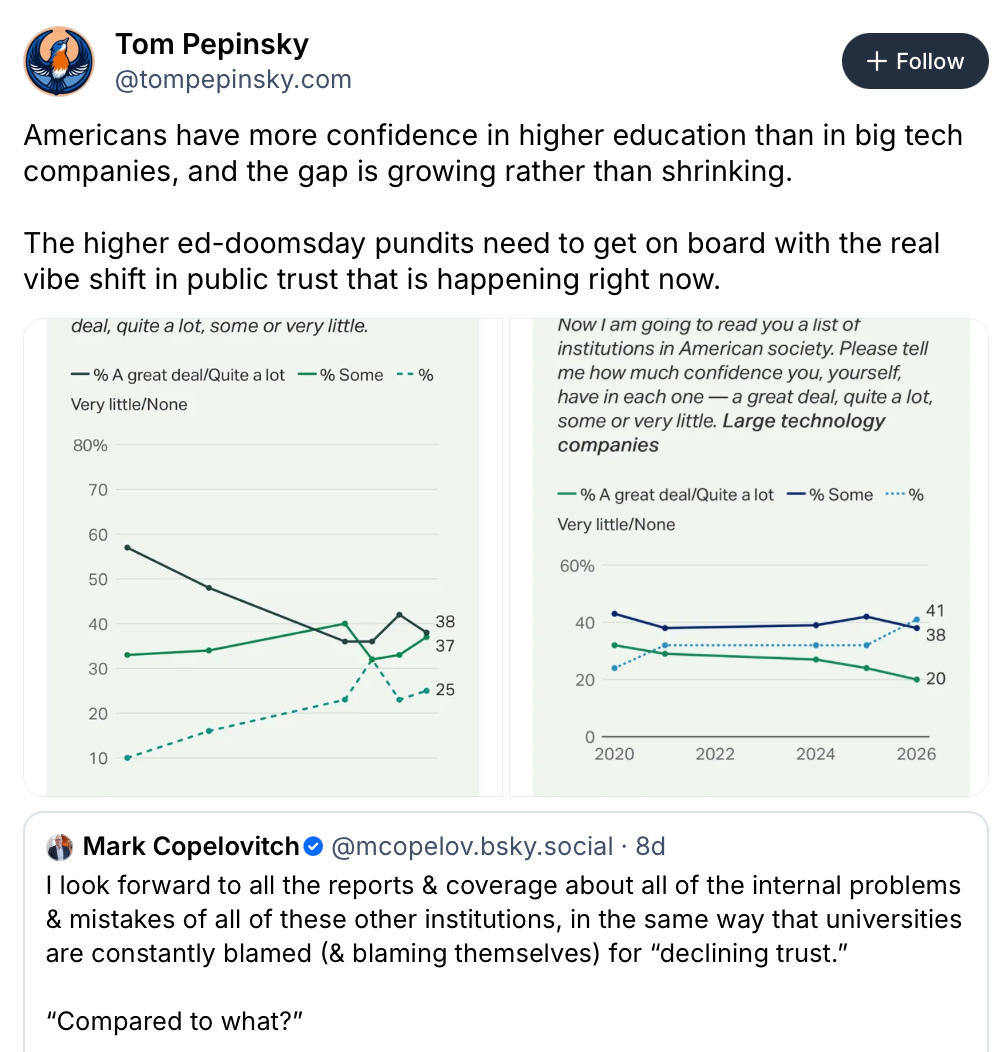
The Hechinger Report’s Jill Barshay noted last week that “A leading school shootings researcher says he was wrong.” (Some people do admit they make mistakes.) Ron Avi Astor, one of the country’s leading experts on school violence, told the audience at the annual gathering of education researchers that, in fact, improving “school climate” -- by reducing bullying and by investing in social-emotional learning and other initiatives -- has not reduced school shootings.
(Like Peg Tyre, who wrote an interesting response to Jill’s story, I’ve never been a fan of social-emotional learning. Peg writes that “these programs sometimes seemed to be providing moral education to public school children without explicitly saying as much. That seems like an overstep and one that raised red flags for me. Parents, not school administrators acting on behalf of the state, should get to decide who imparts a moral education to their children — and how. Some parents do this explicitly by sending their kids to parochial school. Some provide a moral education for their children around the dining room table. Or at Boy Scouts. Or at a No Kings protest.” I’d say that the problem is less that these are a form of “moral education” per se, but that we pretend like it’s something else, like there ever is such a thing as a (morally, politically) neutral classroom. The values of “productivity” and “grit” and “individualism” and “accumulation” and “competition” run throughout the school curriculum and are reinforced by ed-tech in particular. What good does any of this do?)
But god forbid, in our quest to make schools safe and secure, we actually address access to guns. Oh no, see, this is yet another opportunity to expand school surveillance in even more punitive ways -- locking up the precious products, just as we do in the retail drug stores. It’s another opportunity for the ed-tech industry: “Schools are adding pepper spraying drones to help combat active shooters,” The Washington Post reports.
Among the schools that will pilot this new drone system are five in Georgia. The state recently approved a $500,000 pilot program with Mithril Defense.
As I sat at lunch one day this past week with a group of (some but not entirely) Georgia teachers, the topic of school-shooter policy came up. It almost always does when you get teachers from different schools and districts and states together: they compare notes on all these sorts of things: on the latest practices and policies for locking everyone in their classrooms all the time, for example, which makes taking and managing bathroom breaks even more onerous and disruptive.
Labor-saving technologies. Life-saving technologies. But in fact, they're neither. They're deeply corrosive.
We’ve confused “using technology” with “learning.” You don’t learn from technology. You learn from people.
But we’re not talking to one another. We’re on our phones. We’re staring at screens. Hallways at school used to be loud, full of chatter -- happy talk, angry talk, but talk nonetheless. Now it’s quieter. Everyone’s on their phones, even if they’re messaging the person they’re walking alongside. Students might have to put their phones away when they walk into class, but they immediately open up their laptops instead. They’re still largely silent. One teacher commented that some students say it’s often lunchtime before they’ve spoken to another human being.
“A recent study found that people spoke fewer words a day in 2019 than in 2005,” Olga Khazan reports in The Atlantic. What does this do to children’s language development? What does this do to sociality? To community?
What does this do to learning?

This week’s bird is the hyacinth macaw, the largest of the macaws and the largest of the flying parrots. (The flightless kākāpō is larger.)
The hyacinth macaw is mostly blue and can measure up to one meter from head to tail. These birds have extraordinarily strong beaks, which they use for cracking open nuts and seeds, including coconuts and macadamia nuts – according to Wikipedia, they’re one of the only birds with a jaw strong enough to open the macademia, “which takes 300 psi of pressure to crack the shell.”
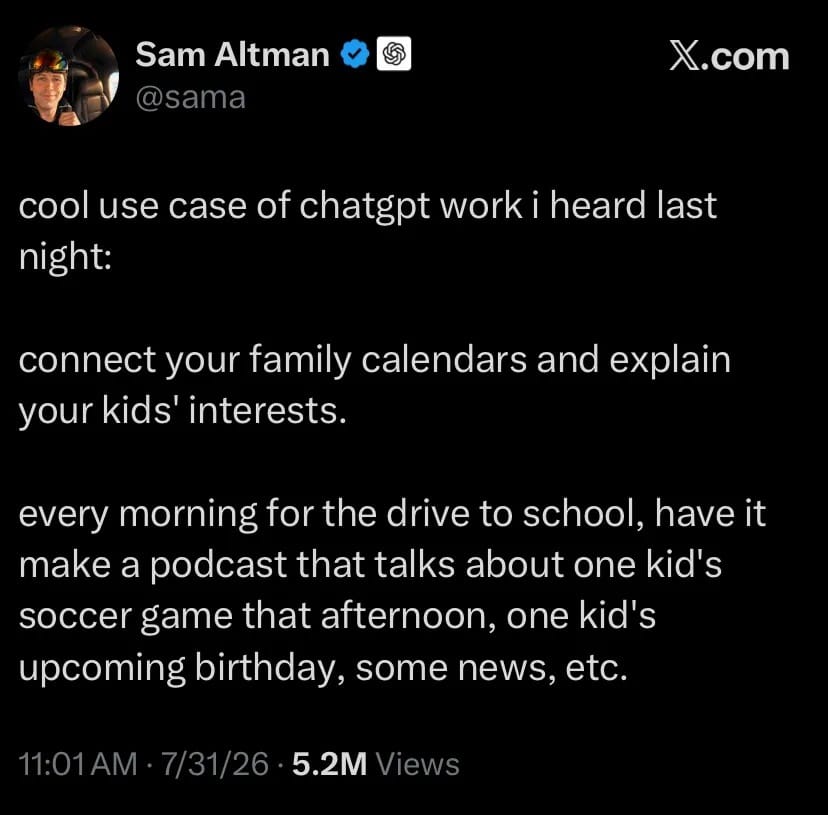
The birds do display some limited tool use, but would not be remotely thoughtless enough to use ChatGPT to make a podcast about their young one’s skills or interests.
Thanks for reading Second Breakfast. Please consider becoming a paid subscriber. Your support makes this work possible.