
The Algorithmic Order


The history of education technology is inseparable from the history of standardized testing.
That’s part of the argument I make in Teaching Machines, where I trace the development of both the machinery of teaching and the machinery of testing back to the early twentieth century. There are more recent connections too, of course: the Obama Administration’s push for computer-based testing in the early 2010s, for example, which led many more school districts to adopt one-to-one computing (and, in particular, to not just buy Chromebooks but to adopt the whole Google framework about what digital work – school- and otherwise – should look like. See Natasha Singer’s forthcoming book, Coding Kids.) And while so much of the reporting on the recent and growing anti-ed-tech sentiment has framed the movement in terms of “too much screen-time,” parents (often the very same parents) have long been very frustrated and very vocal about “too much testing.”
As such, it’s more than a little bit strange then that certain politicians and pundits believe that a winning message right now is “bring back high-stakes testing.” Or maybe it’s not strange at all: maybe all this helps to make clear that the technocratic elite care very little about what people want or need. They aren't even bothering to "read the room."
In a recent op-ed in The New York Times, Ross Weiner argues that the calls to bring back the test-based accountability of “No Child Left Behind” is delusional. (Well, to be fair that’s the word that the headline writer chose: "delusional.") Weiner describes these policies as insufficient then and inadequate now. “Young people are placing more emphasis on purpose, relationships and contribution than on older markers of status,” he argues.
For a generation, the reform coalition took its validation from economists and accountability metrics, while treating parents, students and communities as mere functionaries rather than partners in a shared civic enterprise.
Taking their priorities seriously would mean broadening what we expect from the classroom. Schools should put what students can do on equal footing with what they know, embedding real skills in academic learning rather than leaving them to chance or sequencing them to later in life. Schools should reconnect with the communities they serve, so young people learn through and about the places where they live. And they should reanimate the character-forming, developmental mission a pluralistic democracy requires.
Federal policy has an essential role to play in public education: protecting civil rights, funding quality data and research, and encouraging promising practices to spread. But the formative mission cannot be mandated by Washington. Belonging, the foundation of both learning and civic commitment, is relational and starts local; it cannot be standardized or scaled, but must be cultivated by schools that are responsive to the communities they serve.
It’s not a fully-fleshed out vision for education, to be sure, but it does gesture at something quite different from the technocratic one that schools have spent the last few decades delivering -- and delivering via education technology, via a machinery that shapes the form and increasingly the content, the curricula and the pedagogy. Funny, for all the invocation of "the future of education" from ed-tech evangelists and testing companies and politicians, they're almost always talking about the past, or at least about much older narratives of what that future might look like. (And in doing so, they ignore that computers have been ubiquitous in classrooms for a very very long time now.)
I’ve written quite a bit recently about how nostalgia seems to have circumscribed our ability to think about the future -- in particular, how those building and funding and hyping “AI” are still caught in the “Sputnik moment,” in ideas that are now seventy years old. But as this weird fondness for “No Child Left Behind” certainly demonstrates, there are other eddies that seem to have snared the political imagination.
They’ve caught and captured the pedagogical imagination too, I fear -- I’ve noticed this in so many responses to recent efforts -- in Australia, in the UK, and now perhaps in Canada -- to limit children’s access to social media. Instead of banning technology, some people argue, we need to teach children how to use the technology correctly. We need “critical thinking.” We need “literacy.” (Fill in the blank with a descriptor there: Computational literacy. Digital literacy. Web literacy. AI literacy.) It’s almost as if the past thirty some-odd years of these sorts of lessons have made all the difference and -- somehow simultaneously -- have never happened at all.
I’m not certain if folks are stuck in another era or simply long for another (mostly make-believe or misremembered) era, the one in which they imagine that adjectives like “open” and “critical” were sufficient to bend the arc of technology towards progressive education and away from the school-to-prison pipeline (or its contemporary Fortnite-to-looksmaxxing pipeline).
Things have shifted.
I’m still stewing on one of the essays I linked to last week, Fred Turner’s recent article in The Baffler on “The Texas Ideology” -- on a Silicon Valley that has embraced muscular Christianity, white supremacy, political surveillance, military contracts, and (as ever) resource extraction, and on what all this might mean for education and education technology. (Related: “Texas is poised to require millions of students to study Bible stories,” CNN reports.) "The California Ideology," with its privileging of neoliberalism, libertarianism, and individualism, has been the driving force of so much of ed-tech in the last decade or so – the MOOC was exemplary. And now? And next?
I’ve just started reading Quinn Slobodian and Ben Tarnoff’s new book, in which they argue that “Muskism” has replaced “Fordism” as the new model for capitalism -- a model which has major ramifications not just for “business” but for all of society. (Do recall that one of the key elements of Fordism was that factory workers be paid enough wages to buy things: mass production and mass consumption were inextricable.) And while many people might like focus on Musk’s politics and/or his social media persona -- certainly as good an example as any as to why this stuff is bad for one’s mental health -- it’s worth remembering that, at his core, he is a government contractor: that is the business of SpaceX. (Green tech federal money provided some of the funding for Tesla too.) And the infrastructure that Musk has built and controls -- including the Starlink satellites -- also have a nostalgic bent to them, Slobodian and Tarnoff suggest: not just in the science fiction worlds that Musk read about as a kid, but in his lived experiences in apartheid South Africa.
The future, for Muskism, is an apartheid techno-state.
And I’m sorry, but no amount of “critical thinking” or “‘AI’ literacy” is going to get us out of “fortress futurism,” particularly when the very companies building this fortress subscribe to a vision of algorithmic-ordering of children. (Indeed, they long have, when we consider the origins of standardized testing: in intelligence testing and eugenics.)
Something Wicked This Way Comes:
Via Nature: “Is AI ruining our skills? Early results are in — and they’re not good”
“The problem with evidence production on AI in education,” by Ben Williamson
Arjun Appadurai review Theo Baker’s new book on Stanford: “The University as Giant App”
“Your AI is not a tool,” writes L. M. Sacasas. It is a “denial-of-service attack on the human psyche.”
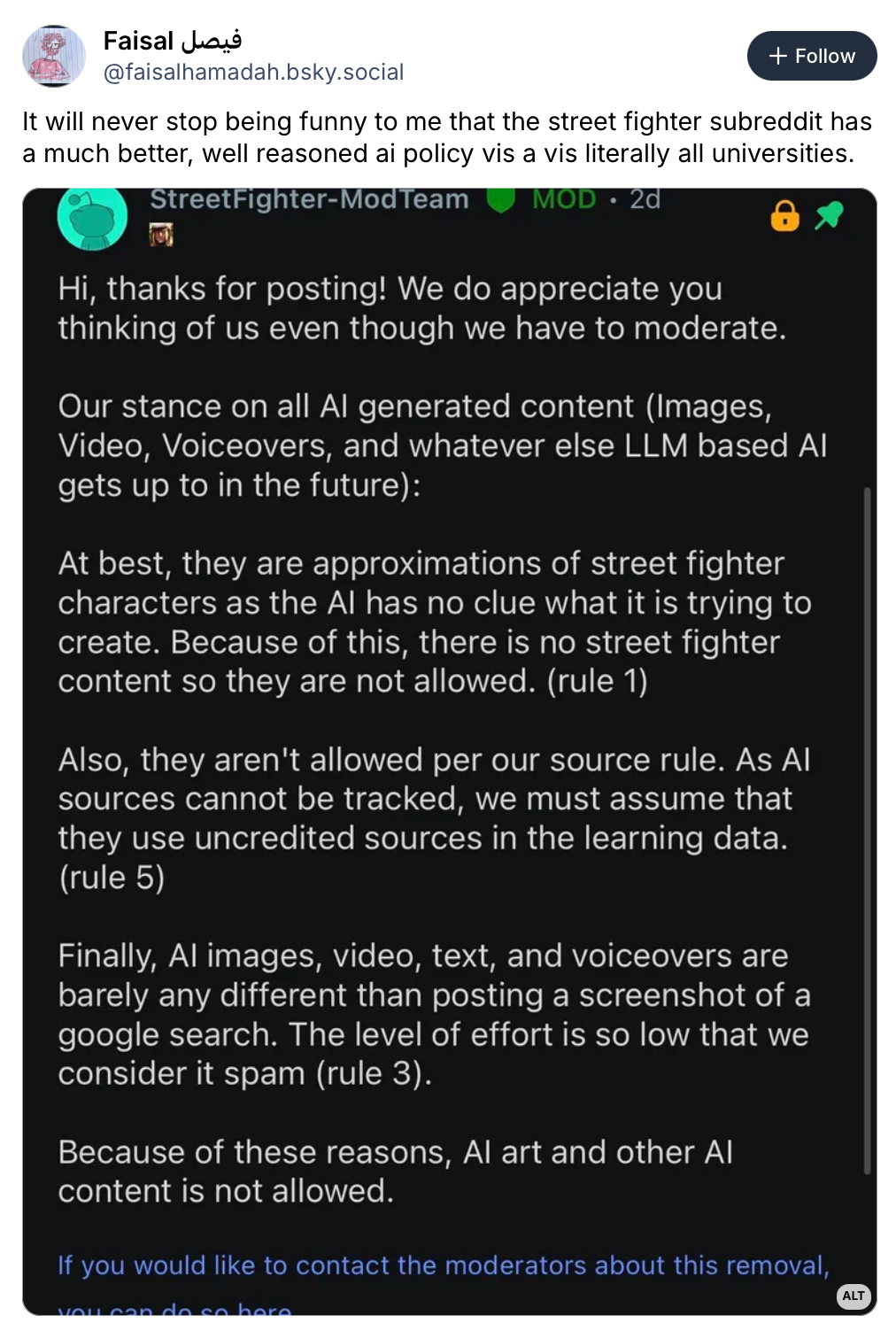
“How to talk about "AI" without adding to the anthropomorphization,” by Emily Bender and Nanna Inie
The words we use really matter. I wonder if, every time someone gets all in their feels about banning social media – this strikes me as language that triggers all sorts of other associations, a lot of them negative, as well as inducing in libertarians their loud regulatory paroxysms (or whatever you call their version of “moral panic”) – we might simply pick different phrasing: this issue, for example involves raising the age limit of who can sign up for these sorts of apps from 13 to 16. I dunno, seems less scary. (Yes, I realize that it's more complicated than that, and that handing over one's ID to access websites seems quite un-good. Then again, there isn't much good in any of the data we blithely surrender.)
Or maybe rather than talking about screen free classrooms (or weekends or whatever) – a phrase that emphasizes the absence of devices but is easily twisted into some sort of lack – we talk about all the things that we are doing instead of staring and scrolling and clicking. This does mean, of course – and this is truly paramount – that we plan for those things, that we reclaim public space for kids, that we fund activities and resources for them and with them. And not because we think they’re broken without their phones, but because we believe that they are whole people, worthy people regardless.

Today’s bird is the prothonotary warbler, which according to Wikipedia, “is named for its plumage, which resembles the yellow robes once worn by papal clerks (named prothonotaries) in the Roman Catholic Church.”
I confess that sometimes my brain misinterprets words – my own little defective autocomplete machine, I guess – and I recently read this bird’s name as “profanatory warbler,” which I thought was delightful. I promptly went to learn all about why the little yellow creature would be cursing/cursed. Oops.
If one were to invent such a reason, it would be perhaps its connection to Alger Hiss and Whittaker Chambers. A Cold War history refresher, we love those here: Chambers had accused Hiss of being a communist spy; Hiss insisted he did not know Chambers. But they both mentioned the warbler in their Congressional testimony before the House Un-American Activities Committee – "gotcha." (Obviously it’s never taken much to convince American government officials that dissenters are part of some vast and violent conspiracy.)
The profanatory warbler’s cry, I imagine, sounds something like “Are you fucking kidding me?!” Over and over and over again.
Thanks for reading Second Breakfast. Please consider becoming a paid subscriber. Your support makes this work possible.